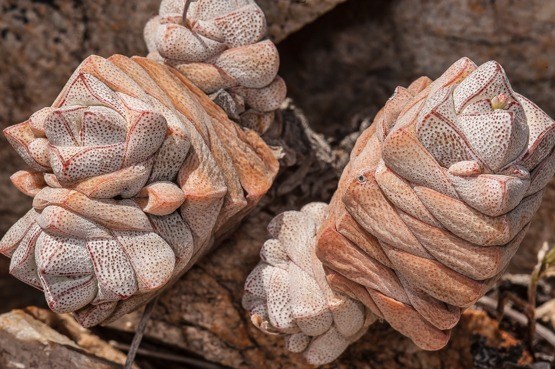
A jewel in the Crassula crown: C. deceptor

Some forms of this species are among the most beautiful that Crassula has to offer and in such a big genus with many attractive species, that’s quite something. As the pictures show, the plants are variable in many respects, especially shape, size and arrangement of the leaves.

When not in flower, the plants are up to 8 cm tall, often with several short branches. Each branch forms a short, 4-angled column up to 2.5 cm in diameter, bearing closely packed leaves which are 0.6-1.5 (-2) cm long and 0.3-1 (1.5) cm wide.
The leaves are acute or obtuse, flat or slightly concave above and very convex below, somewhat boat-shaped and densely covered with hard, almost spherical papillae.
Old leaves will shrivel a lot, but stay attached to the branches.
In December-March the plants produce miniature flowers in small clusters on peduncles 2-8 cm long.
The species is widely distributed in south-western Namibia and in north-western South Africa as far east as Kakamas and south to Vanrhynsdorp, usually on gentle slopes or on rocky outcrops, often among quartz gravel.
Antegibbaeum fissoides

The genus Antegibbaeum contains only this species. It is endemic to the western part of the Little Karoo, where it may occur in great numbers, usually on clayey soil in quartz patches and often accompanied by Gibbaeums.
At first sight, the plants are very similar to those of Argyroderma fissum. They are branched from the base, with upright or flat-growing stems, forming clumps up to 18 cm across.
The leaves of each pair are slightly unequal, greyish-green, sometimes reddish.
Older leaves are often covered in an unsightly black fungus (also see Cerochlamys).
The flowers have short stalks and are deep pink to violet-red; they are to 6 cm in diameter and appear in in late winter and early spring: August-September.
Common names for this species are volstruistone (ostrich toes) and bobbejaanvingertjies (baboon fingers).


With Gibbaeum petrense


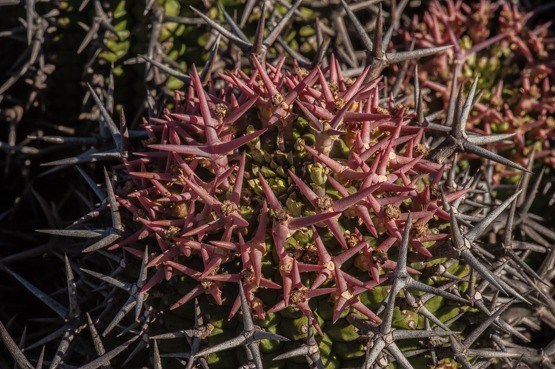
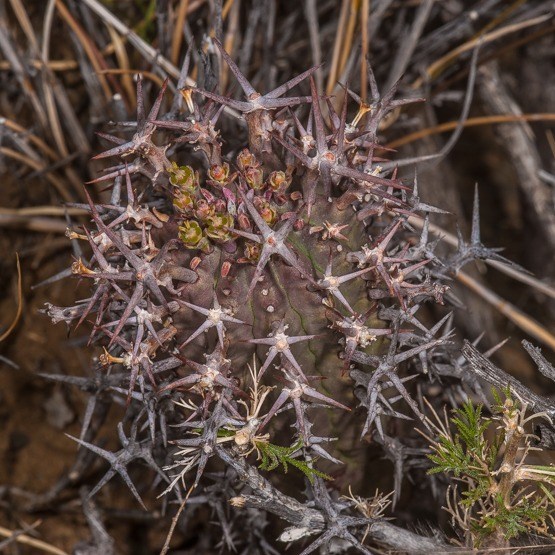
Euphorbia stellispina (skaapnoors, noorsdoring)

Usually found in dry scrub on shallow, stony ground, this attractive species is widespread in the Great Karoo where the plants form more or less dense clumps up to a meter tall and 1.5 m in diameter.

The branches are 3-8 cm thick, cylindrical to club-shaped, with 10-16 angles. The star-shaped spines to which the species name refers, are in fact modified fertile peduncles and are 0.4-2 cm long.
Flowers appear from July to September.