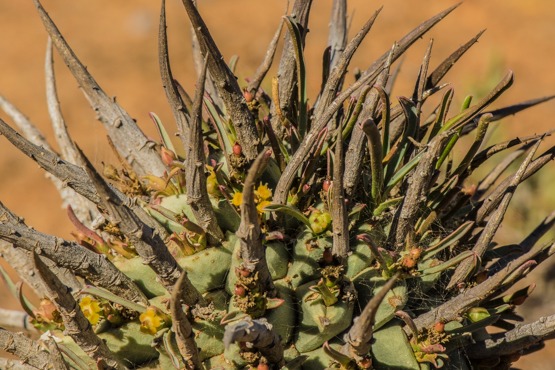
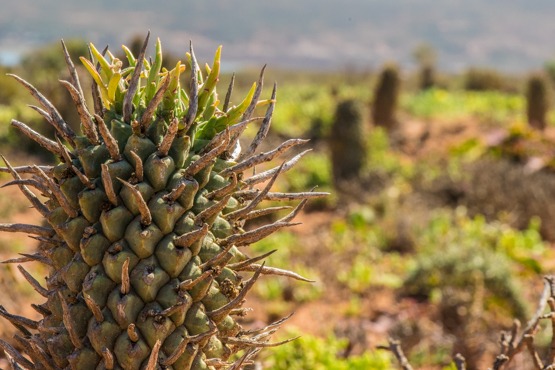
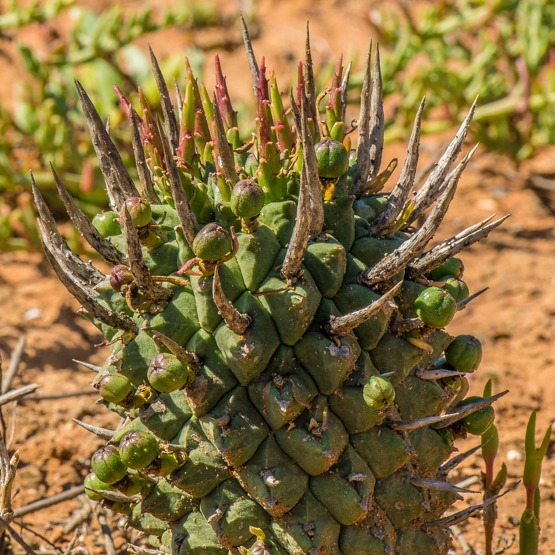
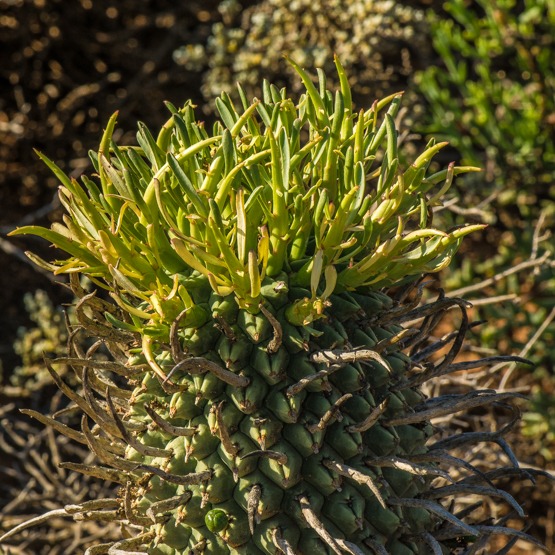
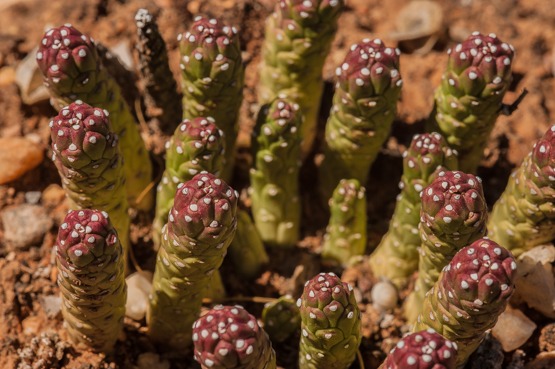
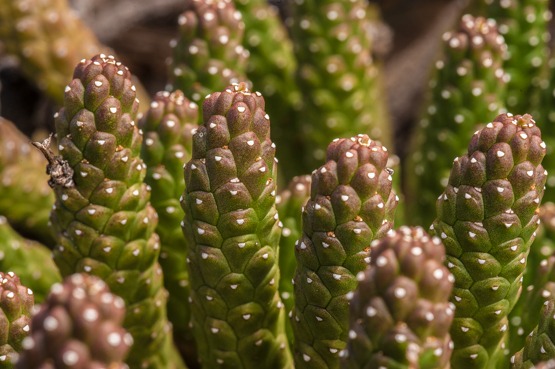
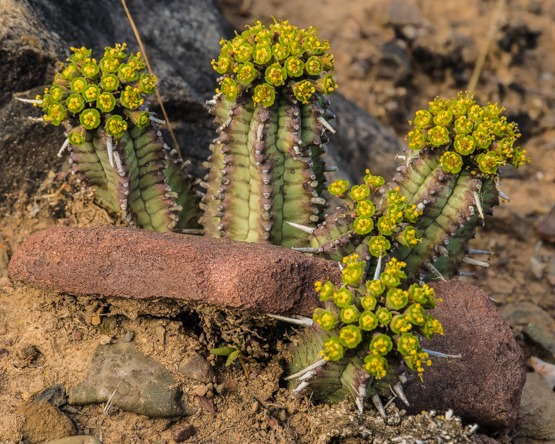
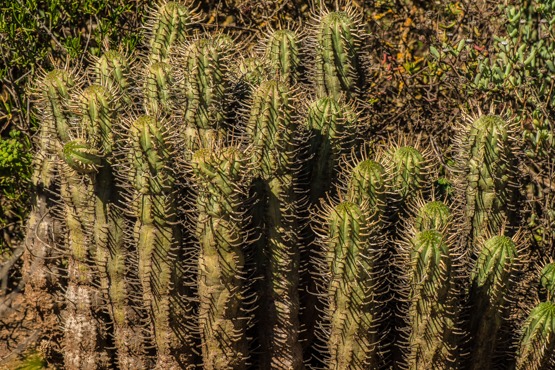
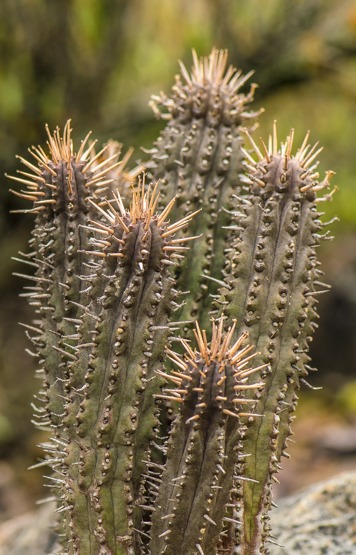
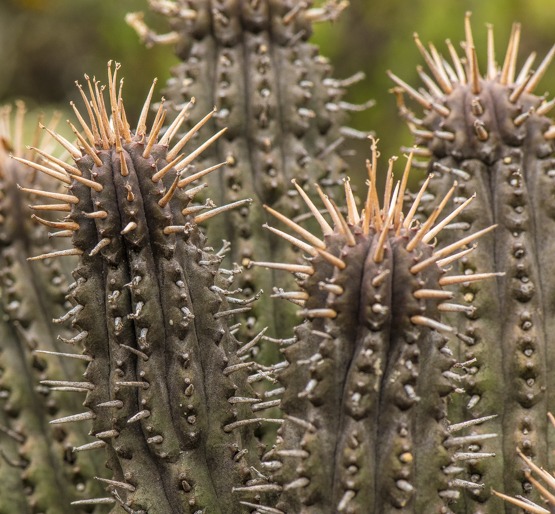
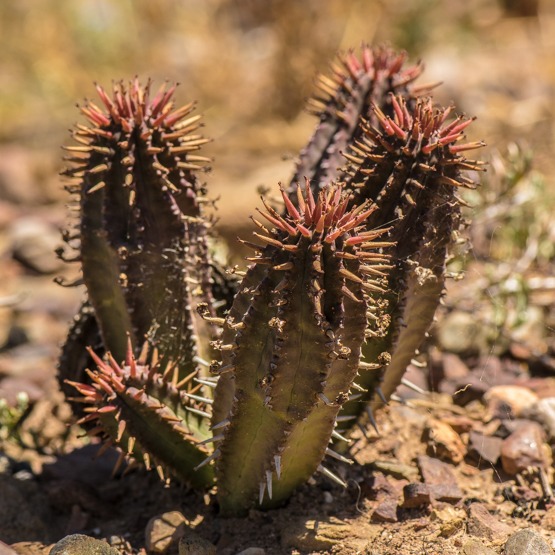
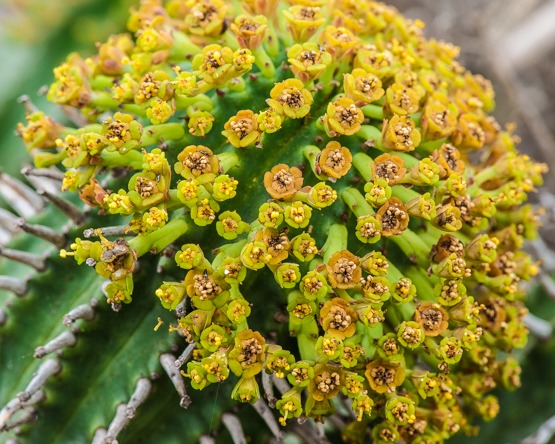
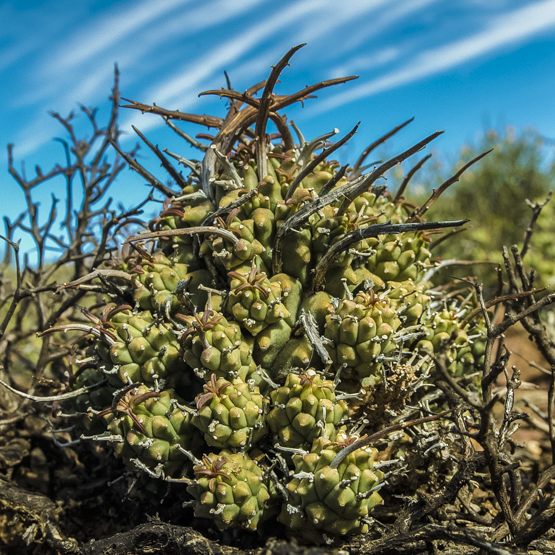
Euphorbia obesa

Guest column by Theo Heijnsdijk

In 1897, professor Peter MacOwan, a British botanist working in South Africa, sent a specimen of Euphorbia meloformis, known since 1774 , to the Royal Gardens in Kew near London. At least that’s what he thought. When the plant came into bloom in the succulents greenhouse in 1899, it clearly turned out to be a different species. According to historiography, this unique plant then disappeared from the Kew collection (probably a concealing way of saying that the plant died). Happily, they had made coloured drawings of the flowering plant (fig.1). That gave enough information to Sir Joseph Dalton Hooker, Kew’s resident botanist, to go ahead with a description in 1903.

Fig. 1 The drawing in Curtis’s Botanical Magazine of the first E. obesa in the Western world shortly before it ‘disappeared from the Kew collection’ (read: died).


Euphorbia obesa is a dioecious species, in other words, a plant which develops only female or only male flowers. The drawing clearly shows a female plant, but in a detailed drawing ‘stamens’ are shown (no. 4 on the plate) and in the description it says: “Filaments anantherous, hirsute”, which means that the stamens are bristly hairy (hirsute) and do no bear anther buds (anantherous). It probably concerns rudimentary stamens that do not develop in a female cyathium. Or would Hooker have mistaken the incised slips of the cup-shaped shell (involucrum) for stamens?

E. obesa remained very rare for some time. In 1907, Alwin Berger in his ‘Sukkulente Euphorbien,’ reported that the Kew plant up to then was the only known specimen. And in the part on the Euphorbiaceae in the ‘Flora Capensis’, N.E. Brown in 1915 reported that only female plants were known. In the Netherlands, the species was first admired in 1924 at the first Succulent Plant Exhibition in The Hague. The owner had bought the plant at the World Exhibition held at Wembley in the same year. In 1926 we find the first photo in the Dutch magazine ‘Succulenta’. Because of its rarity, E. obesa was a coveted plant at the time and people were willing to pay large sums of money for it. As a result, the localities were literally looted once they were known. The South African government recognized that there was a threat of extinction and to prevent that, an export ban for live plants was imposed in 1931.

The species name obesa means ‘thick’, ‘fat’, ‘swollen’. Just think of the new health issue obesity, in which the same word is incorporated. In this context, it is worth mentioning that the plant in South Africa is called vetmensie (‘little fat human’).

Another South African name is ‘klipnoors’. Klip means stone or boulder and noors is the name which in the Jansenville area was given to the common yellow-flowered and rather thorny Euphorbias. These reminded the British of the gorse (Ulex europaeus) found in England. This then was probably corrupted by the Dutch to Noors (‘Norwegian’). The region around Jansenville is now called Noorsveld and ‘Noors’ has become a designation for Euphorbias in general. A klipnoors is therefore a Euphorbia that looks like a piece of stone.
Names in English are: Living baseball, Eisenhower’s golf ball, Baseball plant, Sea urchin (zee-egel). This last one obviously as a reference to a sea urchin’s shell. See Fig. 2 and 3 below.


Fig. 2 Euphorbia obesa subsp. obesa, in South Africa called vetmensie (a fat person).

Fig. 3 The shell of a sea urchin

The species occurs near the town of Kendrew in the Graaff-Reinet district (on the west side of the Eastern Cape). There the plants grow on the top and the southern slopes of low hills, between 300 and 900 meters above sea level and also on the flat parts between the hills. On these flat parts they occur in sandy soil under shrubs, but on the slopes the soil is much more stoney. The colours of the plant body match the environment so well that it is difficult to find one.
In summer, the maximum temperature is on average 26 °C and the minimum temperature 11 °C. In winter it sometimes freezes slightly. The annual rainfall is 200 to 300 mm, spread over two periods. In late spring (October - November) there is some precipitation and at the end of the summer (March - April) larger quantities are registered. Most of the rain falls during thunderstorms. Apparently, the plants are eaten by the numerous baboons and by the cattle of the farmers. The milky juice does not seem to bother these animals.

Fortunately, despite the collecting frenzy of the enthusiasts, there are still some populations left (perhaps overlooked at the time). They are now protected, sometimes even by placing a fence around them.
It is also completely unnecessary nowadays to remove these plants from nature. They are grown in large numbers and the cultivation is certainly not difficult. It is actually incomprehensible that in 1935 it was still thought that the species could hardly be kept alive, as appears from the following fragment from the question and answer section in the October issue of ‘Succulenta’:

“For Euphorbia obesa, the ‘right’ culivation in our country has not yet been discovered. At best, one can keep this most remarkable of all Euphorbias, which only occurs in one part of the Cape Colony (Kendrew in the district of Graaff Reinet northwest of Port Elisabeth), alive for a few years. They slowly wither away in our country: there is usually no question of them getting any bigger.”

For a long time, it was believed that the species indeed only occurs in the immediate vicinity of Kendrew, south of the town of Graaff Reinet, but apparently there are also populations north and northeast of Graaff Reinet.
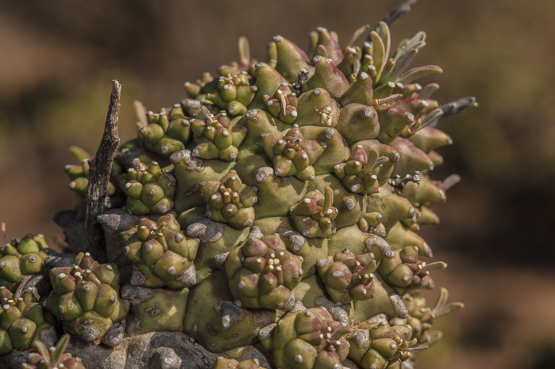
Sensational was the discovery by Robert Allen Dyer in 1939 of a population of a similar plant on Mr. Stegman’s Kruidfontein farm, 19 miles west of Willowmore, on the road to Rietbron. This is at a distance of more than 100 km southwest of Kendrew and in the intermediate area no plant resembling an E. obesa has ever been found. This plant was described in 1941 by White, Dyer and Sloane as a separate species, E. symmetrica (fig. 4).

Fig. 4 E. obesa subsp. symmetrica.

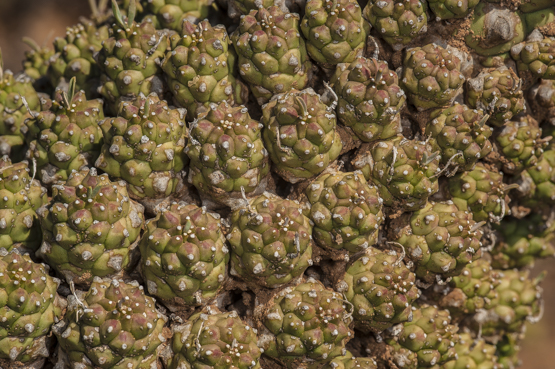
The main difference with E. obesa, in addition to the geographical separation of course, is that the points from which the inflorescences originate (called flowering eyes), are different in shape. In E. obesa they are round dots from which one flowering stem (peduncle) originates, but in E. symmetrica it is an elongated transverse stripe, and this offers space for several (up to 5) flowering stems next to each other (fig. 5). Incidentally, in E. obesa there may also be several inflorescences together, but in that case, they originate from one branched flowering stem.

Fig. 5 E. obesa subsp. symmetrica differs from ssp. obesa in that the “flowering eyes” are stripe-shaped and can thus accommodate up to 5 flower stalks (peduncles).

In addition, E. symmetrica keeps its spherical shape much longer than E. obesa. In the long run, however, it also becomes taller than wide.
Also, in E. symmetrica the taproot is supposed to develop much more vigorously. Later on it was also mentioned that young seedlings are spherical in E. symmetrica and cylindrical in E. obesa. Gordon Rowley in 1998 found the differences too small to distinguish 2 separate species and he reduced E. symmetrica to a subspecies, E. obesa subsp. symmetrica. The original E. obesa is now called E. obesa subsp. obesa.

In an article by Gerhard Marx in the magazine Cactus & Co, some more differences are mentioned: in subsp. symmetrica the head is more sunken than in subsp. obesa; the colored stripe pattern on the plant body in subsp. symmetrica (especially visible in seedlings) consists of fewer, but wider and more pronounced bands than in subsp. obesa and under identical conditions, especially with regard to the amount of light, the colour of subsp. obesa is more purple blue-grey and of subsp. symmetrica green to yellow-brown. Young seedlings are clearly greener in subsp. symmetrica.

Propagation by seed works very well in E. obesa and the seedlings quickly develop into beautiful little balls. On April 29, 2008, I sowed 25 seeds of subsp. symmetrica (from my own plants) in 5 neat rows of 5 in a pot of 8 x 8 cm (at the top). I always sow at a temperature of 25 °C to 30 °C. Within one week, 13 seelings had already emerged. In fig. 6 we see the pot with seedlings on May 18, so barely 3 weeks after sowing. By then the 22nd seedling had just emerged from the soil.

Fig. 6 E. obesa subsp. symmetrica seedlings 3 weeks after sowing.

In fig. 7 we see the same pot on July 13, almost 11 weeks after sowing. Now there are 23 seedlings on display. A success rate of 92%. If the seedlings are not transplanted, sometimes a seed will germinate in the next year. A late vocation, shall we say.

Fig. 7 E. obesa subsp. symmetrica seedlings 11 weeks after sowing.

As far as the soil is concerned, the plant is not very demanding, but a mineral composition is recommended. Water regularly in the growing period and keep dry in winter. According to the literature, temperatures down to -10 °C. are tolerated when the soil is completely dry.
Subsp. symmetrica is perhaps a little more sensitive to cold. In its habitat it does not get as cold as at the localities of subsp. obesa.

Over the years, a whole series of abnormalities has been reported among the countless cultivated specimens of subsp. obesa. Of course, cristates have been known for a long time. Usually they are grafted but this is not really necessary. One of my seedlings from 1998 changed into the cristate form from the beginning. Fig. 8 shows part of this now 14-year-old plant which still has its own root system.

Fig. 8 A 14-year-old seedling of E. obesa subsp. obesa on its own roots.

E. obesa does not normally form side shoots, but in some specimens, shoots are produced from the base. The designation ‘forma caespitosa‘ was coined for this. Bizarre in appearance is ‘forma prolifera‘, in which a new shoot is created from every growing-point. It is very similar to the witch broom disease that occurs in some cacti.
On to deviations in flowering. Under the not so correct title “Impotence in Euphorbia obesa“, J. Mieras reports in 1978 a male plant whose stamens do not develop and in 1979 a female specimen is reported in which the pistil does not develop normally.
Male plants which become females and vice versa also occur. In addition, in 1983 P.H. den Hartog reported a plant of which all cyathia are bisexual. So, both pistil and stamens in one cyathium. In my own collection I have observed in both subspecies that there are male specimens which regularly produce bisexual cyathia and fruits thereof (fig. 9).

Fig. 9 E. obesa subsp. obesa with some bisexual cyathia.

Furthermore, there is the obesa with deformed stamens mentioned by Riet Maessen in the December issue of Succulenta 2012 (fig. 10).

Fig. 10 E. obesa subsp. obesa with monstrose male inflorescences, photo Riet Maessen.

Then there are the plants that proceed to multiple dichotomous division without this leading to the formation of a crest (cristate). These forms are referred to as ‘forma polytomica‘. Mixed forms of polytomic and cristate growth also occur. Gordon Rowley gives these types of shapes the name “Rocky Mountain”. Unfortunately, the species was not designed to undergo such a drastic change in shape and that means that cracks will occur, resulting in ugly brown spots.
I have a few such forms in my possession, all female ones and there is a lot to experience there. To start with, the pistils are not only 3-fold but also 4-, 5- or 6-fold and after pollination with a normal obesa, this results in fruits with 3 to 6 compartments (fig. 11 and 12).

Fig. 11 A monstrose form (“Rocky Mountain”) of E. obesa subsp. obesa with 3-, 4- and 5-parted fruits.


Fig. 12 Close-up of the fruits in Fig. 11.

On one of those plants, a kind of monstrose way of flowering began to develop 2 years ago in which a still expanding lump of cyathia has arisen (fig. 13).

Fig. 13 Monstrose inflorescence in E. obesa subsp. obesa “Rocky Mountain” .


Fig. 14 On the right a seedling of E. obesa subsp. obesa with 3 seed-leaves.

This is a phenomenon that also occurs quite frequently in cacti. Other seedlings will keep making new ribs so that after 1 year there are already about 13 instead of the usual 8. In the second or third year, such a seedling then proceeds to dichotomous division. In fig. 15 we see such a plant after the division is complete and fig. 16 shows such a plant at a more advanced stage.


Fig. 15 After forming about 20 ribs, this seedling of E. obesa subsp. obesa decided that it was necessary to divide dichotomously.


Fig. 16 A plant of E. obesa subsp. obesa divided dichotomously.

So all this refers to offspring of a monstrose female plant that has been pollinated with pollen from a normal male plant. In any case, the phenomenon seems to have a hereditary component. I wonder how big the percentage of abnormal offspring is if the supplier of the pollen is also a monstrous form.

What remains to be told is the fact that E. obesa hybridises rather easily with other species and that the plants in our collections will not all be true to type. As long ago as 1938, ’Succulenta’ contained a picture of E. obesa x submammillaris. In addition, there is a cultivar on the market under the name of “William Denton” which is claimed to be a hybrid with E. mammillaris. Common are hybrids with E. meloformis. Among other things, these are distinguished from the true obesa by the fact that the flowering stems, just like in E. meloformis, usually are not shed after flowering. Hybrids with E. horrida, E. globosa and E. ferox are also known.

LITERATURE

Berger, A. (1907). Sukkulente Euphorbien. Ulmer Verlag, Stuttgart: 102.

Brown, N.E., Hutchinson, J, Prain, D. (1915). Euphorbiaceae in Thiselton-Dyer, Flora Capensis, William Clowes and Sons, London, Vol. 5, sect. 2, part 2, p. 359.

Hartog, P. H. (1983). De sexuele spelingen van Euphorbia obesa. Succulenta 62 (11): 258.

Hooker, J. (1903). Curtis’ Botanical Magazine 129, tab. 7888.

Houten, van den, J.M. (1926). Merkwaardige Euphorbias, Succulenta 8 (7/8): 100.

Killick, D. J. B. (1978). The flowering plants of Africa.

Laren, van, A, J. (1932). Vetplanten, Verkade’s fabrieken N.V., Zaandam.

Marx, G. (2012). The South African spherical spurges, Cactus & Co 16 (2): 70 – 81.

Mieras, J. (1978). Impotentie bij Euphorbia obesa, Succulenta 57 (7): 150.

Mieras, J. (1979). Nogmaals Euphorbia obesa, Succulenta 58 (8): 203.

Rowley, G. (2006). Teratopia, Cactus & Co.

Sluys, van der, C. (1938). Euphorbia obesa x Euphorbia submammillaris, Succulenta 20 (1): 11.

Thoorn, J.J.E. van de, (1935). Vragenrubriek, Succulenta 17 (10): 159.

White, A., Dyer, R., Sloane, B. (1941). The Succulent Euphorbieae 2: 559, Appendix A: 964.

First published in Succulenta 92 (6), December 2013. Translation from the Dutch by F.N.
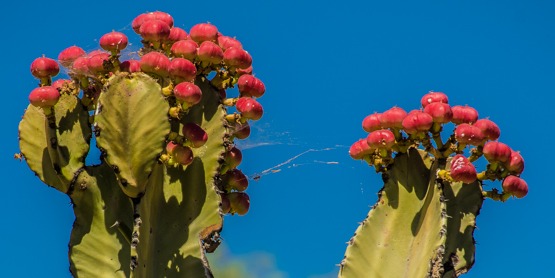
 

Euphorbia abyssinica

Even though this is not the most imposing of the tree Euphorbias, a mature specimen is a sight for sore eyes, especially when it is decorated with its big bright red fruits.

When fully developed, the trees may be 9-10 m tall, with a short bulky trunk and a dense crown of upcurved stems. The tips of the branches are usually 4- angled, 4 to 6 cm wide, and regularly constricted into oval segments to 15 cm long; the angles are straight to shallowly waved.
The spine shields are triangular, to 1 x 0.7 cm; they are separate and become corky with age. The spine pairs are up to 0.5 cm long, often not completely developed or apparently absent.
The cyathia are 1.2 cm across, with golden yellow glands; the fleshy
fruits are about 1.5 x 2 cm, first white, then turning bright red, and hardening over time.

Euphorbia abyssinica occurs at altitudes between 840 and 1460 m in Sudan (Red Sea Hills), Eritrea, N. Ethiopia, Somaliland, and N. Somalia, on dry stony slopes and bushy savannahs, sometimes growing on its own but often locally dominant.

The stem is used for firewood and as timber and the sap is sometimes used in traditional medicine and to kill ticks on cattle.
In suitable climates, the species is grown as an ornamental house plant and also as a garden plant. It is best propagated by seed because cuttings do not develop the characteristic trunk.

Euphorbia grandicornis (Guest column by Theo Heijnsdijk)

Name
Euphorbia grandicornis is a representative of the large group within the genus of shrub-like succulents with spine pairs, also referred to as the diacanthium section. Plants belonging to this group usually have 2 spines that are facing outwards from the edge of a shield. Another example of a member of this group is E. canariensis. Sometimes there are 3 or 4 spines and sometimes only one (for example, in E. unispina).
Grandicornis literally means ‘with large horns’.
In English-speaking countries, the plant is also called ‘Cow’s horn Euphorbia’. The thorns remind me more of the tentacles of a snail. See Fig. 1.

In the next image, we see (between the spines) the scars of the tiny leaves that are formed in the new growth and that will soon turn yellow, shrivel, and fall off.

Other names that are widely used are ‘Big horned Euphorbia’, ‘Rhino thorn’ and even ‘Zig-Zag Cactus’. There is also a cristate form and this looks even much more ferocious than the normal plant. In Afrikaans, the plant is called renosterdoring (a renoster is a rhinoceros and doring stands for thorn).

History
The plant has probably been in cultivation for quite a long time, but for many years it went undescribed.
We first come across the name Euphorbia grandicornis in 1889 in the first part of the 2-volume book ‘Pflanzenbiologische Schilderungen’ by the German professor of botany dr. Karl Immanuel Eberhard Ritter von Goebel. In a general story about Euphorbias, he discusses a number of aspects of E. grandicornis as if it were a well-known plant. It is nothing like what we mean by a description nowadays. However, we do find a beautiful pen drawing of a top cutting (Fig. 3).

In addition, there is a drawing of the leaves in the new growth and of a cross-section of the trunk in which the peculiar, twisted shape of the winged ribs is clearly illustrated (Fig. 4).

Von Goebel reports that he has not been able to find any data on the habitat. However, from the physical appearance of the plant with the wide thin ribs and therefore a large surface area - similar to, for example, leaf cacti- he concludes that it is unlikely to be exposed to long dry periods in its natural environment.
After von Goebel it was quiet until 1893. In that year, an article by a Mr. J.E. Weiss, Reader in botany, appeared in the periodical ‘Dr. Neubert’s Deutsches Garten-Magazin’ under the title “Empfehlenswerte Cacteen” (“recommendable cacti”). He took the concept of cactus rather broadly because the last ‘cactus’ discussed in his article is Euphorbia grandicornis. There is even a photo, the very first one published, but the print quality was rather poor in those days (Fig. 5).

Original description
The plant was still not officially described at the time. That was done in 1897 by Nicholas Edward Brown in part 26 of Hooker’s Icones Plantarum. That is why the author’s citation which is always added to the species name in scientific literature, in this case is ‘Goebel ex N.E. Br.’. The description by Brown, who was employed by Kew Gardens near London, was based on a plant that had been cultivated there since 1876. The description with Latin diagnosis was accompanied by two drawings of quite a big specimen. I don’t particularly like these drawings. Brown also mentioned a locality: South Africa, Umfolosi River, Zululand.

Habitat
Nevertheless, there was apparently uncertainty as to where the plant occurred in nature, because in 1904 in Engler’s ‘Botanische Jahrbücher’ ( ‘Botanical Yearbooks’) in a monography on Euphorbia’s in the section Diacanthium the author, F. Pax, writes: “Vaterland unbekannt, vielleicht Africa” (Native country unknown, maybe Africa). And in 1907 Alwin Berger in his ‘Sukkulente Euphorbien’ says: “Homeland ?” and further down:
The origin of the plant is unknown. However, it is not plausible that it was only recently introduced, because the large specimen in Kew mentioned above, indicates that it is an old inhabitant of our greenhouses.). Brown and others later compiled the part about the Euphorbiaceae in Sir William T Thiselthon-Dyer’s ‘Flora Capensis’. This part appeared in 1915 and here E. grandicornis is also treated. The last line I find quite funny: “Distribution: Easter Region: Zululand, stone! Marriott! And cultivated specimens!”.
I suspect Marriott is a name, but I haven’t been able to find any information. But especially all those exclamation marks intrigue me. I have no idea what the writer wanted to emphasize with this.
In modern literature, it is made clear that the range is quite large: South Africa (Kwazulu-Natal), Swaziland, Mozambique, Kenya. There the plants grow at low altitudes (up to 400 m) in small groups between grass or shrubs. They have 3 or 4 ribs and can be up to 2 m tall. It seems that large plants often succumb to their own weight. The variety sejuncta (described in 1970 by Leach), which remains smaller and sometimes grows lying down, has 2 or 3 ribs and is known only from a site in Mozambique. There it grows in the company of Aloe chabaudii, Euphorbia corniculata and E. tirucalli on granite slopes at altitudes between 380 and 700 meters.

Flowering
In a sunny location, a plant that is preparing to flower stands out because of the vivid red colour of the developing cyathia (Fig. 6).

These appear on the uppermost and therefore youngest, segments of the stems. There are always 3 cyathia together, but often only the middle one will fully develop. It only produces male flowers (stamens). The two outer cyathia are bisexual. First, the male flowers develop (Fig. 7)

and when they dry out, the female flower (pistil, fig. 8) follows.

All cyathia are bright yellow in colour. This type of inflorescence with a central male inflorescence flanked by 2 bisexual cyathia is often found in Euphorbias, for example in E. canariensis.
Ripe fruits are about 8 mm in diameter and purplish-red in colour (Fig. 9).

Fruit formation in a E. grandicornis in Jan Celliers Park (Pretoria, South Africa). Photo Dr. Johann C. Knobel.

Cultivation
A well-drained mixture with little organic material and a lot of additions such as lava, pumice, clay chunks, etc. is recommended. It’s best not to use peat. Give ample water from March to September. In winter, the temperature should be at least 12 °C, but preferably a little higher. Propagation is by cuttings, which root quite easily, or by sowing. Seed is fairly well available and it is fascinating to see how a wildly thorned plant develops from the delicate seedling with its 2 cotyledons (Fig. 10).

In frost-free areas, E. grandicornis is recommended for hedges. Pruning is well tolerated. Goats eat the corners off but leave the thorny sides alone. The juice doesn’t seem to hurt them.

Literature:
Berger, A. (1907). Sukkulente Euphorbien: 52-53.
Brown, N.E. (1897). Hooker’s Icones Plantarum 26, plates 2531, 2532.
Brown, N.E.; Hutchinson, J.; Prain, D. (1915). Euphorbiaceae in Thiselton-Dyer, Flora Capensis 5, sect 2, part 2: 367-368.
Goebel, K. von (1889). ‘Pflanzenbiologische Schilderungen’ 1: 62-63.
Pax, F. (1905).. Monographische Übersicht über die afrikanische Arten aus der Sektion Diacanthium der Gattung Euphorbia in Engler’s Botanische Jahrbücher 34: 74.
Weiss, J.E. (1893). Dr. Neubert’s Deutsches Garten-Magazin 46: 291.

First published in Succulenta 92 (4) 2013. Translation from the Dutch by F.N.
 

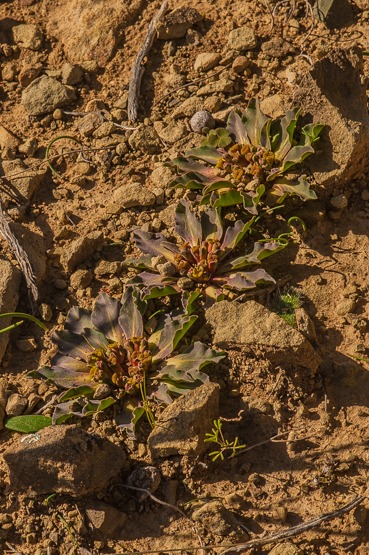
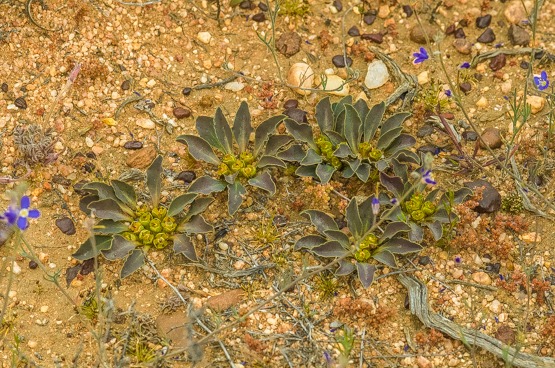
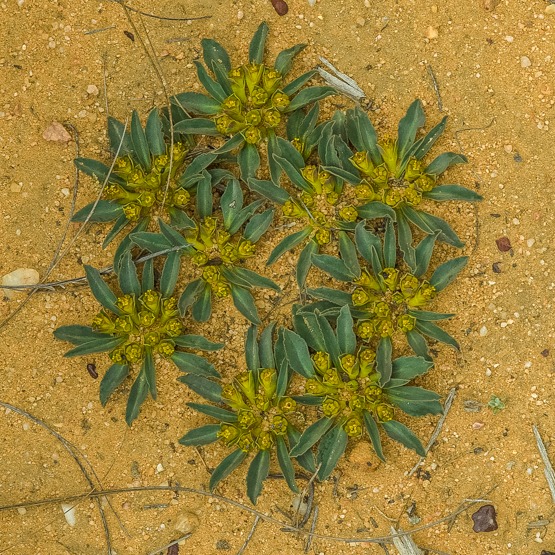
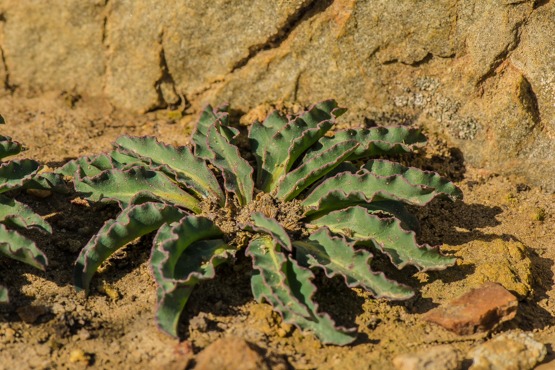
Euphorbia tuberosa (incl. E. crispa)
Common names: Melkbol, Wilderamenas

This member of a small group of geophytic Euphorbias has underground tubers up to 2.5 cm thick which can form large groups. The plants are stemless and either male or female.

Its leaves have a stalk up to 5 cm long and may be oblong to almost lanceolate, linear or elliptic,1 to 5 cm long and 0.5 to 2.5 cm wide, often minutely hairy and grey-green, usually with wavy margins. They are only present in the growing period.
The flowering season is mainly June-September.

The species occurs on sandy and gravelly flats and slopes from near Springbok to the Cape Peninsula and the western part of the Little Karoo.


Euphorbia schoenlandii (Noordpol)

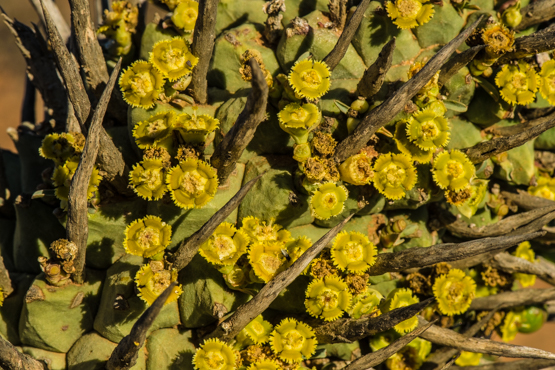
With its robust columns up to 1.3 m tall and up to 20 cm in diameter, this species is often easily spotted from far away. Its distribution area is southern Namaqualand, where it occurs on sandy/loamy flats.
The stems are simple or rarely branched and have large hexagonal tubercles and short-lived leaves. They are decorated with sharp hard spines which are derived from sterile peduncles and up to 5 cm long.
The inflorescences (cyathia) are usually solitary on short peduncles and appear in April-June.

E. fasciculata is similar, but much smaller and does not have sharp pointed spines.


A rare crested specimen

Hope for the future


Euphorbia colliculina (vingerpol)

Only known from 4 localities between Calitzdorp and De Rust in the Little Karoo, this species is highly endangered by habitat loss and degradation (caused by ostrich farming and quarrying as well as soil erosion and urban expansion). The situation is further exacerbated by ruthless collecting.
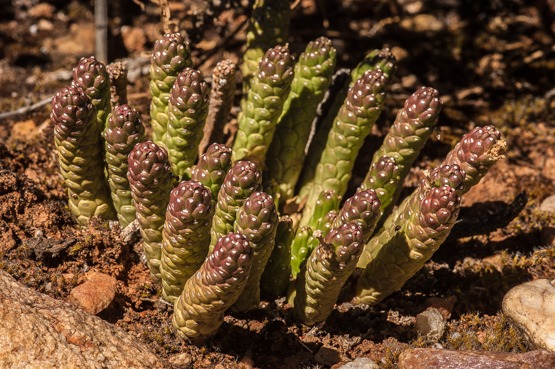
It is a member of the medusoid (caput-medusae) group: the plant consists of a large caudex, an underground tuber and rings of erect to spreading branches which are 3-12 cm long and to 2 cm thick.
The species is said to be close to E. fortuita occurring further west in the Ladismith area.


Euphorbia nesemannii

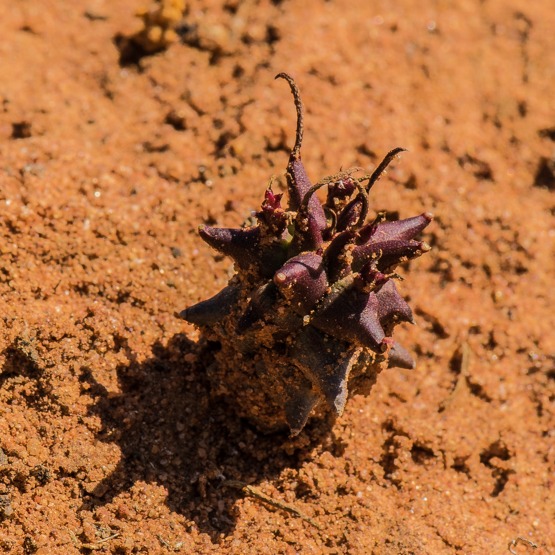
In general, this species is similar to E. mammillaris or heptagona, but it combines a very short main stem with a tuberous main root, so that it forms a roughly cylindrical body which is almost completely hidden in the ground.
The branches are more or less upright, 1-3 cm in diameter and 8-40 (-70) cm long; they have 6-14 angles, with or without weak spines which -if present- are spreading and 1-2.5 cm long.
The plants flower in March-August and are found in open scrubland on lower gravelly slopes in the Worcester-Montagu-Swellendam area.
As witnessed by the pictures, the plants may be very variable, depending on the habitat conditions.

Euphorbia stellispina (skaapnoors, noorsdoring)

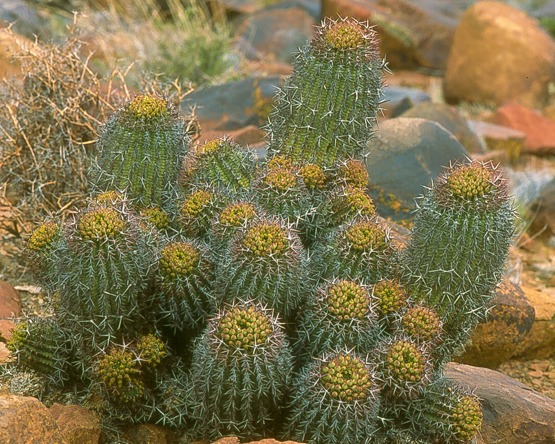
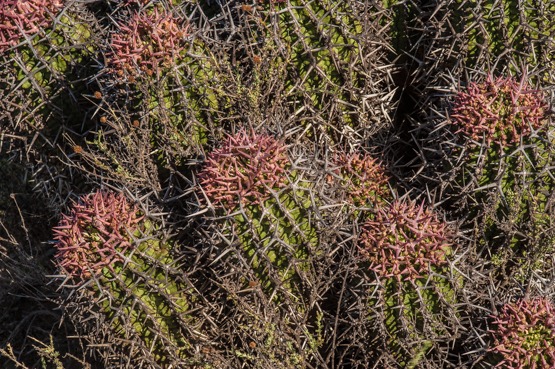
Usually found in dry scrub on shallow, stony ground, this attractive species is widespread in the Great Karoo where the plants form more or less dense clumps up to a meter tall and 1.5 m in diameter.

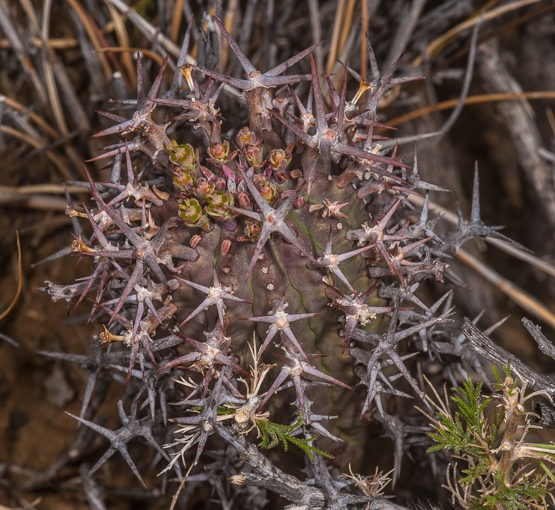
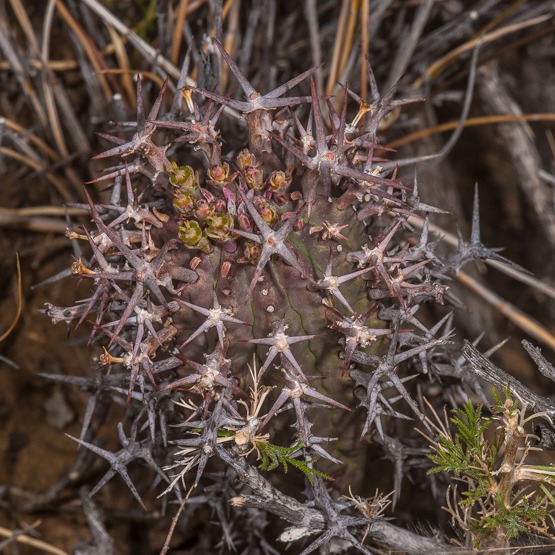
The branches are 3-8 cm thick, cylindrical to club-shaped, with 10-16 angles. The star-shaped spines to which the species name refers, are in fact modified fertile peduncles and are 0.4-2 cm long.
Flowers appear from July to September.


Jatropha mahafalensis

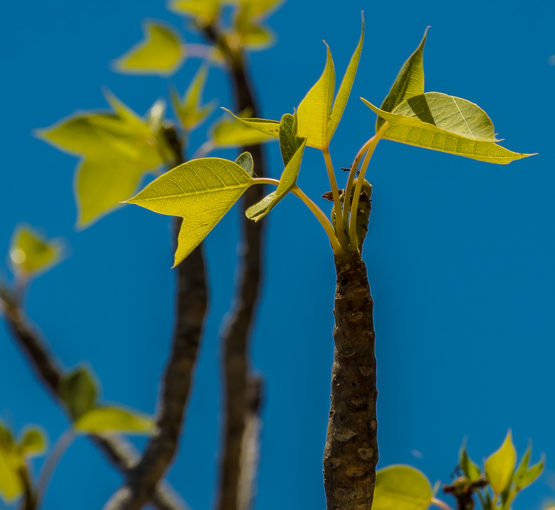
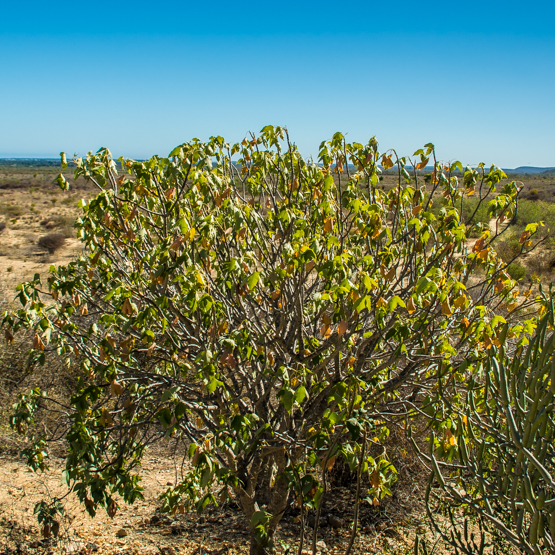
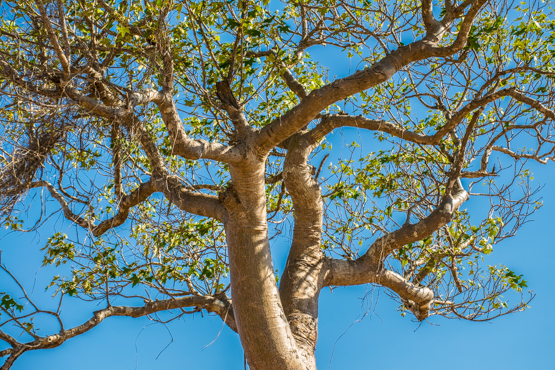
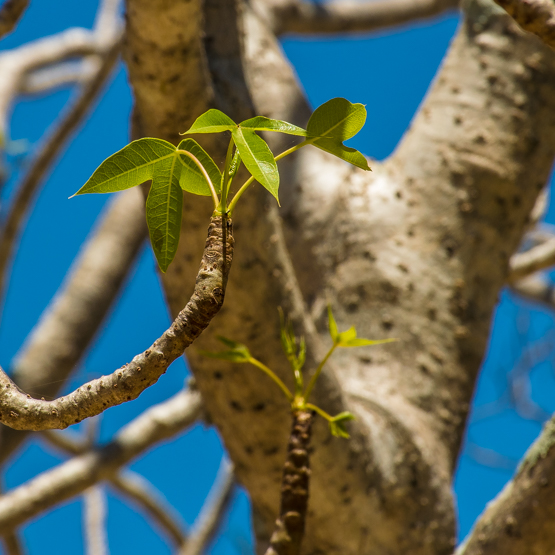
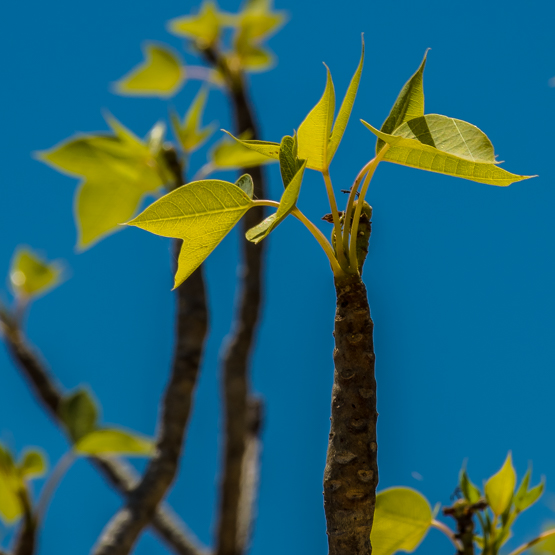
These large shrubs or small trees are up to 6 m tall, usually much-branched from near the base. The young branches are softly woody and have big leaves (to 6 x 8 cm), with 3-5 triangular lobes.
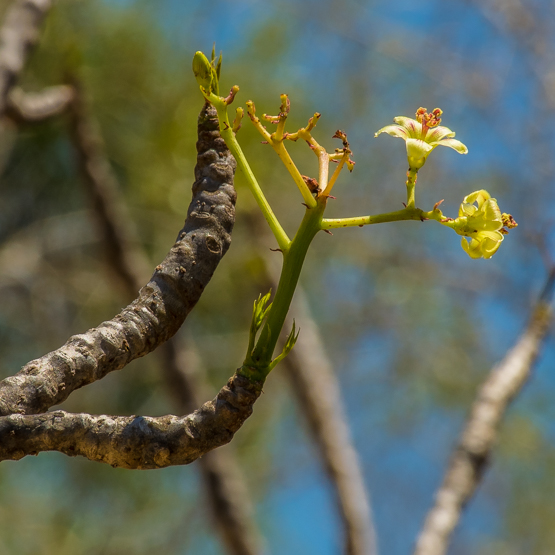
The unisexual flowers are creamy-white with red stripes near the base and produce large green capsules. Oil from the seeds was traditionally used for lighting but nowadays also for manufacturing glycerine, soap and biofuel.

The species is widespread in dry bush and forest in southwestern Madagascar, especially on limestone, and is the only Jatropha that occurs naturally on the island.

Euphorbia multiceps (part 1 of 2)

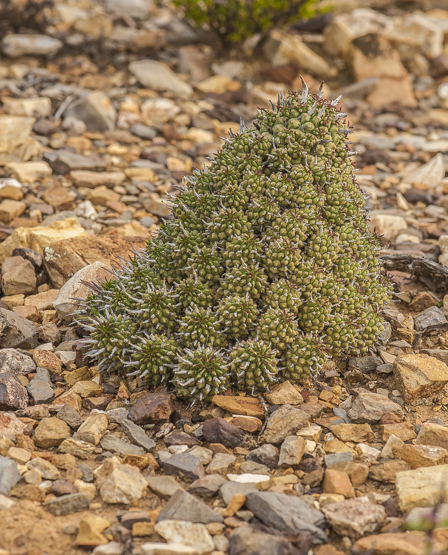
Among all the various growth forms in the genus Euphorbia, the design of this species stands out as something singular.
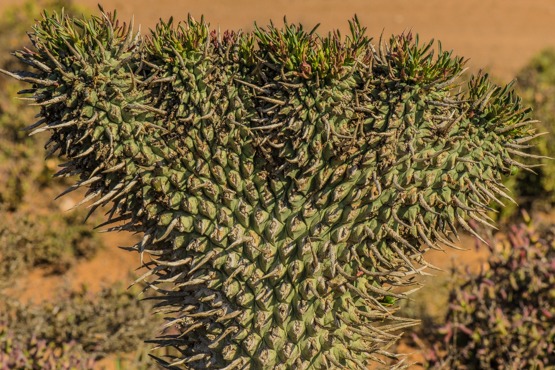
The plants consist of a thick main stem covered with numerous branches up to 8 cm long, decreasing in length towards the top of the plant.
In this way, a compact cone is formed up to 60 cm tall and to 25 cm across at base. In some cases however, the plants are not shaped quite so neatly, resulting in a far less appealing and peculiar habit of growth (see pictures).
The spines are in fact sterile flower stalks; they are 0.8 to 7 cm long and arise from both main stem and branches.
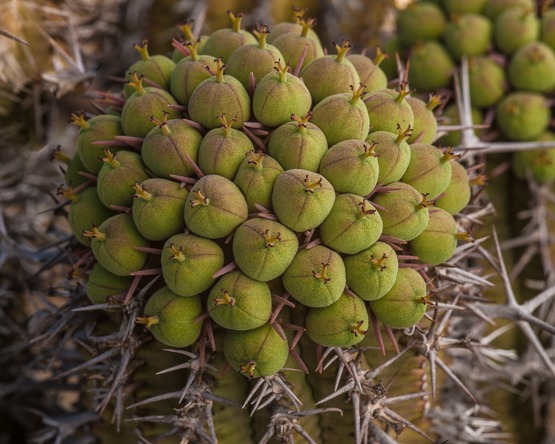
The species occurs on stony slopes and flats from Steinkopf in Namaqualand to the western Little Karoo.