This could well be the most common Anacampseros, both in the wild and in cultivation. In nature it occurs wide-spread from the Worcester to the Grahamstown area on rocky flats and slopes.
It is a robust species compared to its siblings, forming clumps up to 5 cm tall from a thick, fleshy root-stock.
The leaves are to 3 x 1.8 cm, arranged in rather lax rosettes. They are triangular in cross-section and range from egg-shaped to almost circular when seen from above, with an acute tip and short hairs (shorter than the leaves) at the base.
The relatively stout inflorescence is 5 - 15 cm tall, with 1 - 4 flowers.
After good rains the plants will resemble the one in the first picture.
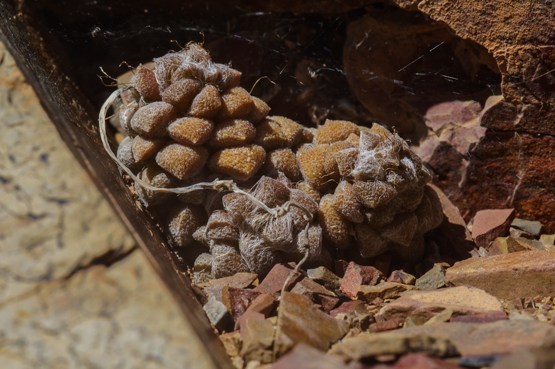
Under more stressful conditions the plants turn yellowish/brownish/reddish, so that they are often difficult to find (especially when they grow in crevices like the next three ones).
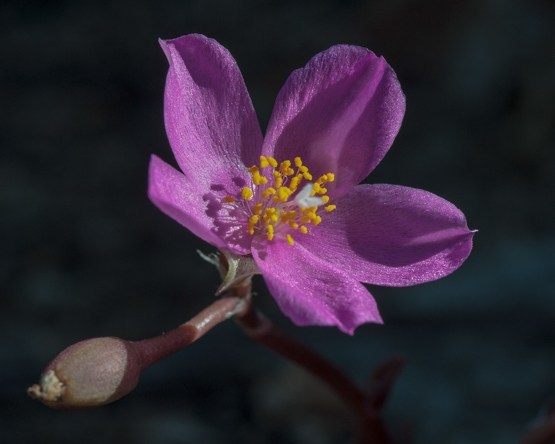
The dark pink flowers are 3 - 3.5 cm in diameter and open for 1.5 - 3 hours in the late afternoon and only when the sun shines. In dull weather they stay closed and pollinate themselves. Most flowers appear in November-December.
The basket-like fruits have a charm all of their own.
When you have a first look at the kind of habitat this species is found in, it looks bare and desolate.
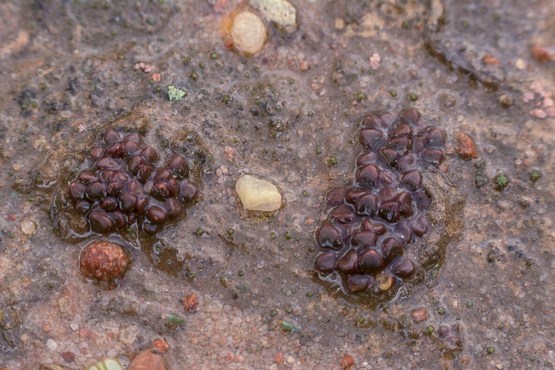
The photo below was made in the beginning of April after good rains, so one would expect a lot of activity going on. And there is, but the plants growing here are so small, that you have to look properly to see them. Accidentally, the other interesting dwarf succulent growing in this spot near Nieuwoudtville is a Conophytum named after the same person (Prof R.H. Compton, the second director of the National Botanical Gardens in South Africa). More about that at a later stage.
The plants grow in very shallow depressions in flat sandstone rocks. After rains, the depressions are filled with water and the little plants are often completely submerged for some time. The following picture was taken in September.
In the dry period the plants are often almost invisible (the picture below was taken in November). Can you see the little caudexes?
The last picture gives a better idea of how charming these miniatures are when in flower (the caudexes are only 1-2 cm in diameter and 1-1.5 cm tall) .
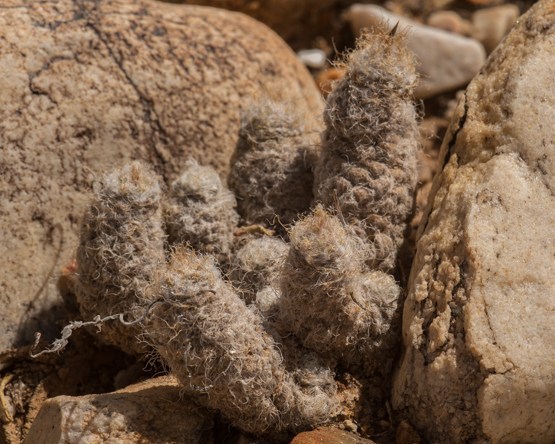
Plants of this species are found widespread in the Great and Little Karoo on stony slopes, usually sheltered by rocks or bushes. They are columnar and relatively thick, up to 4 cm tall (when not in flower).
The flowers are white to pale pink and appear mainly from October to January.
The flat-topped rosettes of this species appear in small clusters from a caudex 1,5-2 cm in diameter. The leaves are not more than 10-11 mm long. These miniatures occur from southern Namibia to Riversdale in southern South Africa, growing on rocky flats and slopes.
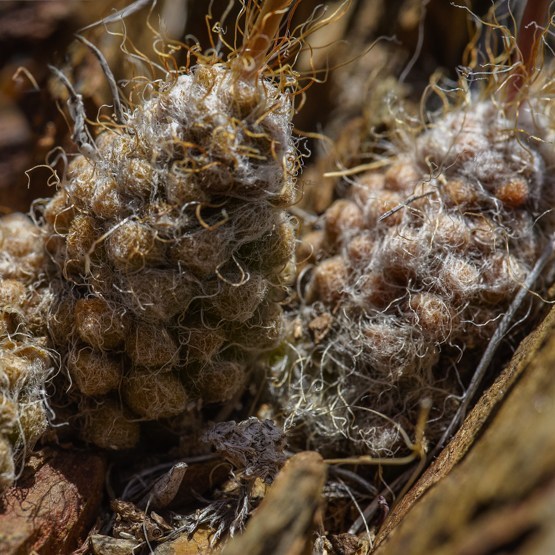
It is easy to take this species for granted, even in spite of the cobwebby hairs it is decorated with.
The following is a quote from Gordon Rowley’s booklet ” Anacampseros, Avonia, Grahamia. A grower’s Handbook” :
“This attractive and distinctive species seeds itself freely around the glasshouse and has long been cherished or tolerated in collections of succulents. The abrupt tapering of the leaf to a spiny tip is its most distinctive feature”
This sounds to me like a nice example of damning with faint praise.
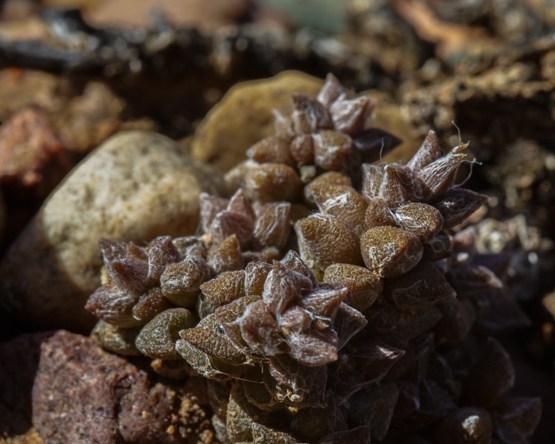
When one inspects the plants a bit closer, the beautiful, almost reptile-like surface texture of the leaves is revealed. I must confess that since I have discovered this characteristic, I look at these plants with renewed respect.
Strange though it may sound, up to yesterday I never managed to make a decent picture of a fully open Anacampseros telephiastrum flower.
Yesterday afternoon I went out to Kanonkop (Cannon head), a rocky outcrop overlooking Montagu. Although I did not find what I had hoped to see, there were several other interesting plants, including a lot of flowering Anacampseros telephiastrums. In fact I have never seen so many plants of this species together in one spot. The flowers appear in November and December; they only open late afternoon (the pictures were made at about quarter past four).
For the first picture I just made a photo of what was in front of the camera. The result was not really exciting, to put it mildly.
For the second one I positioned my camera bag in such a way that it shaded the background. Because of the great contrast in light between the flower and the dark background, the flower was totally overexposed.
When I took the same picture but with one stop underexposure (and somewhat more close up) the result was as follows.
This was the basis for the last picture, which was enhanced in post production by lowering contrast and highlights and raising the clarity, combined with a bit of cropping.
When looking at all those beautiful and unusual forms, colours and textures in succulents, it is easy to think that all this is there for our enjoyment. I’m afraid that is not the case; most of it is purely functional. For me, instead of being disappointing, this fact adds to my pleasure and admiration. What can be more likeable than things that are both useful and pleasing to the eye? In this post we will have a look at some of the contraptions that succulents use to conserve water.
The one thing that sets succulents apart from all other plants is their ability to store water that they can use during periods when there is no external supply. Obviously it is not much use to store a lot of water if you do not have the means to conserve it as well. Managing the stored water sparingly, mainly has to do with reducing transpiration.
The rate at which plants lose water by transpiration is influenced by a number of factors: size and form of the plant, temperature, humidity, intensity of sunlight, precipitation, wind speed, land slope etc.
On some days the temperature of the soil surface may rise as high as 75 degrees C, but a few centimetres higher up it will usually be much cooler (up to 40 degrees less ). The two extremes will be separated by a layer of still air.
Comparable layers with gradients of humidity and temperature are found above plant surfaces; they have a great influence on transpiration. These layers are disturbed or even destroyed by wind. Because of this, many succulents have a cover of hairs, spines, etc. on the surfaces of their leaves or stems. This helps in producing and protecting these layers. Such a cover also gives a certain shade and helps to diminish exposure to strong radiation –especially when it is light in colour. It has been found that tissue temperatures below spines of the cholla cactus (Opuntia bigelovii) can be reduced by as much as 11 degrees C.
In this Anacampseros albidiflora, short hairs on the leaves and long bristles between them, cooperate to keep the plant cool
Pelargonium barklyi is a tuberous plant. Although the leaves are short lived, it is apparently worthwhile to protect them with a cover of hairs
Haworthia arachnoidea gets its name from the spiderweb like cover of hairs. This variety is called scabrispina because the hairs are rough and hard like spines
In Senecio scaposus the leaves look like covered in felt
Many people think that spines are only there to protect the plants against browsing animals. In line with what we have discussed here, I think that spines play a certain role in that respect too, but that it is not the only, or even the most important, one.
In cases like Othonna euphorbioides (above) and Euphorbia stellispina -and in many other plants- the spines are actually hardened remains of inflorescences
Leaf and stem surfaces are often thickened too, or coated with a layer of wax (Senecio stapeliiformis, on top) or cork (Othonna herrei)