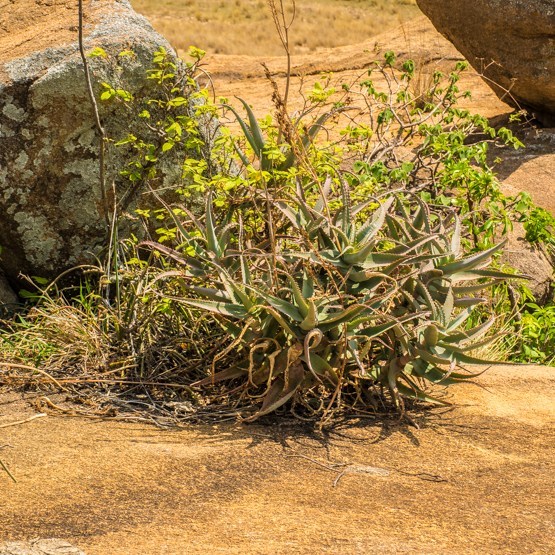
Aloe vaombe

The vernacular name vahombe (the big Aloe) is very apt for this both impressive and beautiful species reaching a height of 2-3 m (sometimes even more).

The unbranched stem is topped by a dense crown of 30-40, up to a meter long, leaves; these are dull to bright green, unmarked and U-shaped in cross-section; young ones are more or less erect, older ones spreading to much recurved, dried remains persistent.
The flowers are about 2.8 cm long, orange to bright crimson red (rarely yellow) and arranged in branched inflorescences; they appear from May to July.

Plants occur widespread in dry bush and spiny vegetation in the south and southwest of Madagascar from the Ambovombe area to Tulear; inland to Berenitra and Sakaraha.
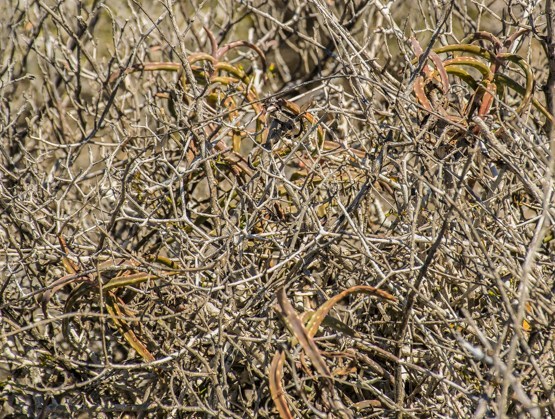
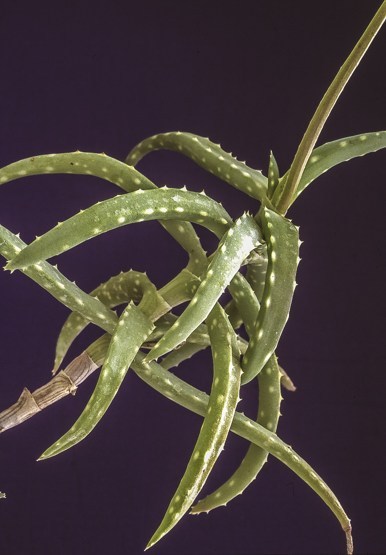
Aloe millotii

This attractive and easy to recognize species is only known from Tanjana Vohimena (Cap Ste. Marie), Madagascar’s southernmost point.
It grows here in full sunshine or partial shade in xerophytic bush on limestone, exposed to strong and almost continuous winds.

The plants are creeping with raised tips or climbing, with branches 20-25 cm long (up to 50 cm when supported by bushes).
When young, the leaves are arranged in two vertical rows on opposite sides of the stem (spiralling with age); they are horizontally spreading but curved back in the upper third, 6-10 cm long and 0.7-0.9 cm wide.
The scarlet to yellow flowers are to 2.2 cm long.

The last two pictures were taken in cultivation (scans from old slides).

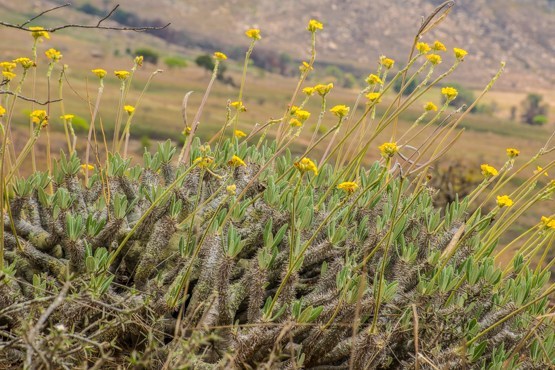
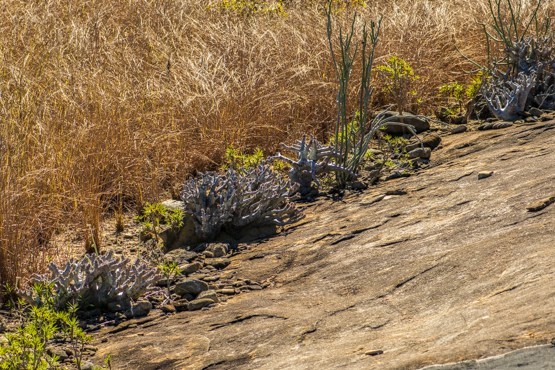
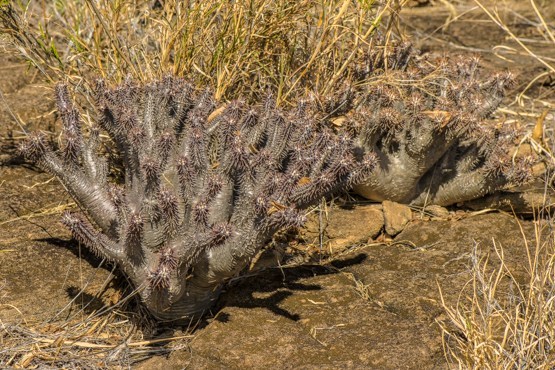
Pachypodium densiflorum

Without flowers, this species is similar to two others (P. horombense
and P. rosulatum), but they are easy to tell apart when flowering.
The plants are widely distributed in the central highlands of Madagascar, where they are often abundant in thick layers of black humus on inselberg slopes and rocks at altitudes between 200 and 1750 m.
They grow into shrubs of 10 to 50 cm tall and 1.5-2 m in diameter.
The branches are densely covered with pairs of spines and each has 3-5 deciduous leaves (to 10 cm long and 5 cm wide).
The inflorescences are 25 to 40 cm tall, with up to 30 flowers at the same time.


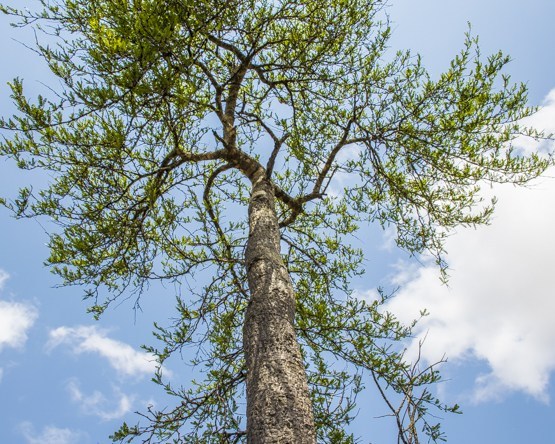
Jatropha mahafalensis

These large shrubs or small trees are up to 6 m tall, usually much-branched from near the base. The young branches are softly woody and have big leaves (to 6 x 8 cm), with 3-5 triangular lobes.
The unisexual flowers are creamy-white with red stripes near the base and produce large green capsules. Oil from the seeds was traditionally used for lighting but nowadays also for manufacturing glycerine, soap and biofuel.

The species is widespread in dry bush and forest in southwestern Madagascar, especially on limestone, and is the only Jatropha that occurs naturally on the island.

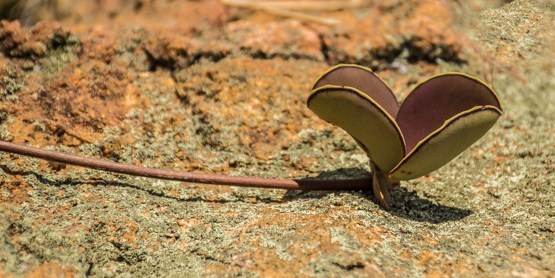
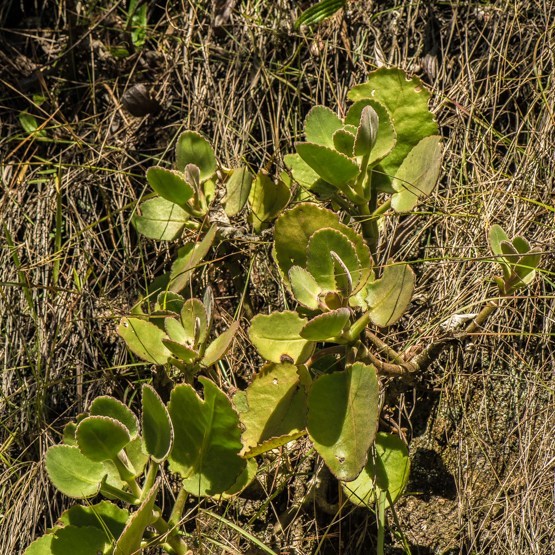
Kalanchoe synsepala

This characteristic species always reminds me of strawberry plants, as it is the only Kalanchoe producing runners (sometimes up to over a meter long!). It is not uncommon in open, rocky places in the mountains of Madagascar’s Central Plateau.

The plants usually have a short thick stem and the leaves are variable in size, shape and colour, usually 6-15 cm long and 4-7 cm wide, glabrous or with short hairs; the margins may have strong teeth and are sometimes dissected.
The compact inflorescences have up to 30 white to purple flowers with a 7-12 mm long, 4-angled tube.

Cynanchum perrieri

One can come across this species on the gneiss and granite plateaux of Madagascar’s Central region at altitudes between 1200 and 1600 m, where it grows in full sun with Pachypodium densiflorum, Aloe capitata var. capitata, Euphorbia leucodendron ssp. leucodendron and other succulent and non- succulent plants.

It has stems 0.8-1.5 m tall and 9-13 mm across, usually erect, not twining, round or slightly angled, covered with wax and smooth or slightly rough.
The inflorescences have 10-15 greenish-yellow, cup-shaped flowers.
Pictures taken near Zazafotsy, 12th June 2017.

Aloe acutissima var. acutissima


Densely branched bushes of this variety, up to a meter tall and to more than a meter in diameter, occur from Fianarantsoa in the central highlands of Madagascar to Tulear in the southwest and Beloha in the south; in the highlands they are locally abundant.
They grow in thin soil on granite, gneiss and limestone rocks, often in the shade of other bushes.
The plants are variable in the size of the stems and leaves as well as the flowers.
On average the leaves are 30 x 4 cm, grey-green with reddish tinge, without markings.
The inflorescence is to 50 cm long, undivided or with 2-4 branches; the flowers are coral-red with pale red tips.

Kalanchoe pubescens (incl. K. aliciae)

Although the plants are very variable in almost all respects, they are always completely and densely covered with white to reddish hairs (except the inside of the flowers).
They have erect to creeping stems, 0.5-1.2 m tall and with egg-shaped to round leaves 16-40 cm long and 0.6-3 cm wide, often with an auriculate* base. The upper leaves are stalked, the ones near the base without stalks.
The inflorescenses are 15 cm wide and produce bulbils; the flowers have 1.4-3 cm long tubes and are red, pink, or yellow, often with red stripes.
The species occurs in central, eastern and northern Madagascar, usually on damp or wet rock surfaces.
Several varieties have been described, but they are not upheld in the Illustrated Handbook of Succulent Plants.

*auriculate: with small roundish or ear-like appendages.

Plants photographed in June 2017


Operculicarya (part 2, O. pachypus)

Here the trunk is only to about 1 m tall and to 50 cm in diameter, conical to irregularly pyramidal, with silver-grey bark.

The branches are hairless, often strongly zig-zag and frequently terminating in a sharp spine; the leaves are 1.5-3.6 cm long with 3-4 (sometimes 5) pairs of leaflets which sometimes touch each other.
The flowers are yellowish-green.

The species has a limited distribution around Toliara, at altitudes from sea level to 500 m, growing in dry thickets on limestone. It is known from only 5 localities and considered endangered. This situation is exacerbated by collection of wild plants.

This species was only described in 1995 and before that time was usually misnamed O. decaryi.

Operculicarya (part 1, O. decaryi)

Operculicarya consists of 5 species of deciduous shrubs or small trees with conical or irregularly swollen trunks, warty-bumpy bark and gnarled branches. The genus is endemic to Madagascar and belongs to the Anacardiaceae, a family of over 800 species mainly occurring in the tropics and subtropics, including well known crop plants such as pistachio, cashew nut and mango.

O. decaryi is the most widespread of the genus and occurs in dry forests in the southwest and south of the island.
It can be a small shrub or a tree, up to 6 m or more tall, with tuber-like roots*. The trunk may be parallel-sided, bottle-shaped or conical, is up to 1 m in diameter and has silver-grey or dark grey bark.
The twigs are slender, more or less straight to strongly zig-zag; young ones sometimes hairy. The leaves are 2.5-6 cm long with 4-9 (usually 5-7) pairs of leaflets, which do not touch each other.
The bright to dark red flowers are either male or female.

Like O. pachypus, the plants are becoming increasingly rare in the wild and are listed in Appendix II of CITES.

* these can be used for root cuttings.