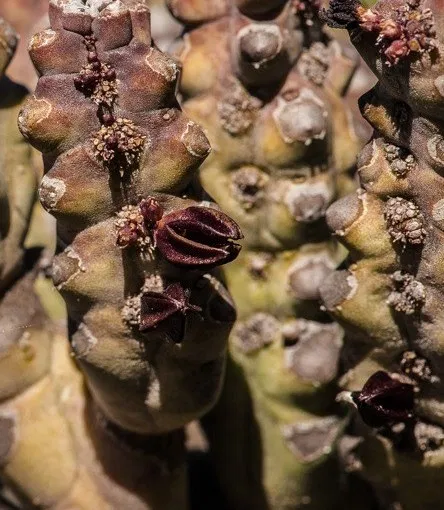
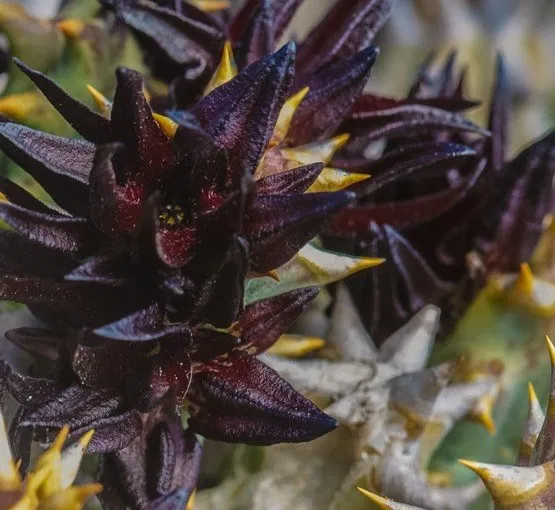
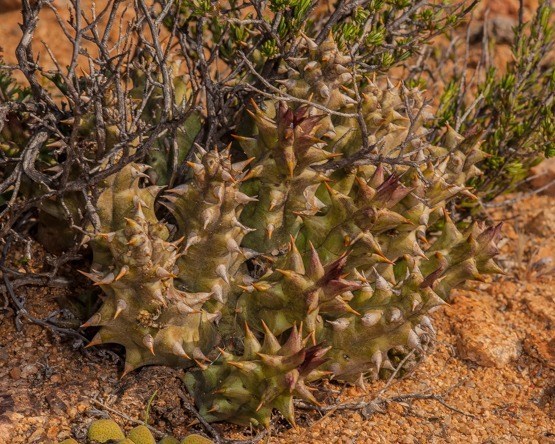
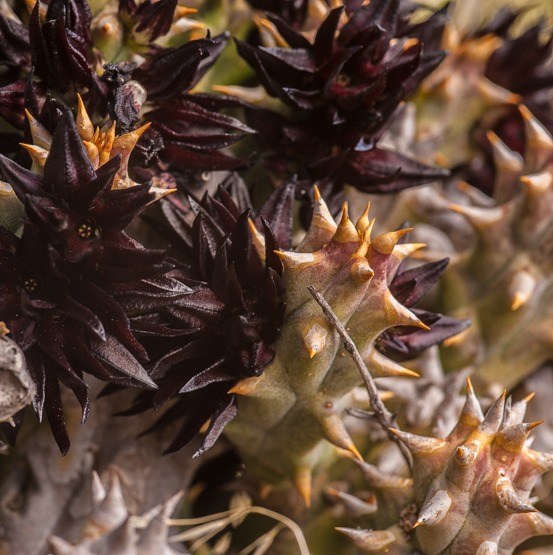
Because of its unusual stems, this species is normally easy to recognise.
It occurs in the Little Karoo and the southwestern Great Karoo on lower stony slopes and hilltops, usually inside or next to other bushes.
The flowers appear normally in March-May, in small clusters near the top of the purplish to greyish green stems. They emit a strong smell of buck or sheep urine.
Of all species of Quaqua, this is the one with the widest distribution and also probably the best known.
The plants form vigorous clumps of up to 60 cm tall and wide.
Even when not in flower, the plants are usually easily recognised by their size and the hard, yellow-brown spines. The flowers appear in March-June and emit a very unpleasant smell.
Occurring in a great variety of habitats from southern Namibia to Rietbron in the Great Karoo and Oudtshoorn in the Little Karoo.
This is one of the more easily recognized mesembs, only known from the Prince Albert area, where it occurs on flats and hills with broken dolerite and quartz gravel.
The old name Bijlia cana cannot be used anymore; vernacular names are Prince Albert vygie, pangavygie and skewevygie.
The plants grow in small clumps of smooth and hard, boat-like but very asymmetric leaves, which are almost as broad as thick in the upper half and pale greyish green to pinkish/yellowish white.
In July-August they produce bright yellow or orange-yellow, short-stalked flowers to about 3.5 cm in diameter.
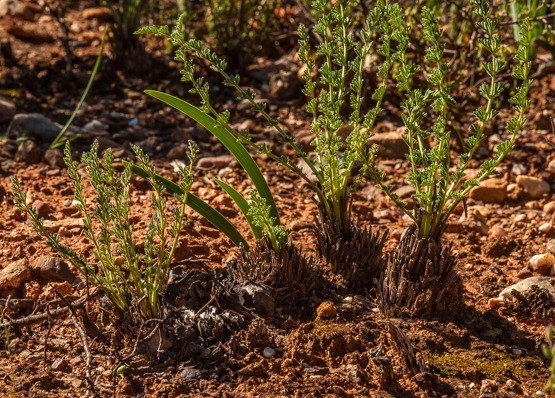
Unlike most other dwarf South African Aloes, this species is usually single, but sometimes 2 or 3 rosettes are formed and rarely even up to 10.
Each rosette consists of 20-30 greyish-green to bluish-green, waxy leaves, 12-15 cm long, with soft to hard white spines on both sides and on the margins.
The inflorescences are simple and dense, 15-25 cm tall with very thick stalks. The flowers are about 5.5 cm long (remarkably large for such a small plant) and have a very long style (=longistyla); they appear in June-August and are salmon pink to coral-red.
Usually growing in the shade of small shrubs, the plants occur on stony or sandy flats, sometimes on gentle slopes, from Laingsburg and the Little Karoo to Middelburg and Makhanda (= Grahamstown) in the Eastern Cape. Unfortunately, the plants are short-lived and don’t grow well in cultivation, not even in the area where they occur naturally.
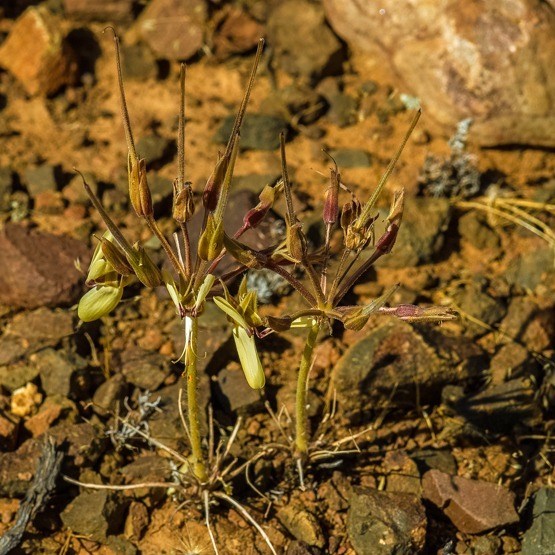
Occurring from the northern Richtersveld to the Eastern Cape Province, this is one of the most common of the tuberous Pelargoniums and also the one with the widest distribution. It is found in a wide range of habitats, from stony slopes and flats to farmland that has been left fallow; it can even quickly colonize disturbed areas.
The tubers are often partly exposed and usually turnip-shaped (= rapaceum); usually there is only a single tuber, but sometimes a string of additional tubers is formed so that the plants can become quite large.
The softly hairy leaves are up to 40 cm long and 4.5 cm wide.
In October – February the plants produce branching peduncles with up to 50 flowers which are about 2.5 cm in diameter, white, cream, yellow or pink and most unusual in resembling little pea-flowers.
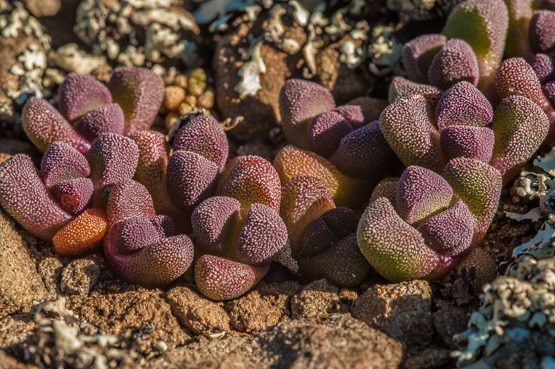
Stomatium is one of the few genera of the Aizoaceae with obviously scented flowers. This species even derives its name from that fact (suaveolens = with a sweet smell).
The plants form compact, flat to somewhat rounded clumps with rough leaves which are 1-2 cm long, 0.9-1.5 cm wide and 0.7-0.9 cm thick.
Usually the yellow flowers appear in May-July; they are to 1.5 cm in diameter and open in the evening.
The species occurs on flat rock slabs (see first picture) in the Fraserburg – Sutherland - Williston area, where severe frost is a normal phenomenon in winter.
In the second picture you may also spot Crassula corallina.
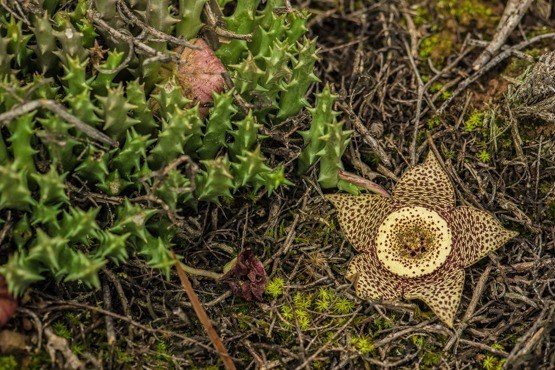
This was the first stapeliad to reach Europe from South Africa, which probably at least partly explains the enormous number of synonyms. It is also one of the most widely cultivated stapeliads and is found in many subtropical areas as a garden escapee.
In the wild it is widespread in the southwestern Cape, mainly along the coast from Lambert’s Bay to Humansdorp, but also in the southern Great Karoo as well as the Little Karoo. It generally occurs on stony slopes, often under shrubs.
The stems are mostly erect, to 15 x 1 cm (excluding the teeth), obtuse or conspicuously 4-angled,
green with purple-brown markings. They form clumps usually up to 20 cm across, but sometimes up to over 1 m.
The flowers appear in Dec.-Sept., usually one per stem. They smell of carrion, which attracts the flies by which they are pollinated. The corolla is 4.5-8 cm in diameter and very variable in colour: inside cream to greenish-yellow, with rather large, purple-brown dots; the annulus is usually paler yellow and more finely dotted.
Photos taken 13 March 2019 on Zolani-Bonnievale road.
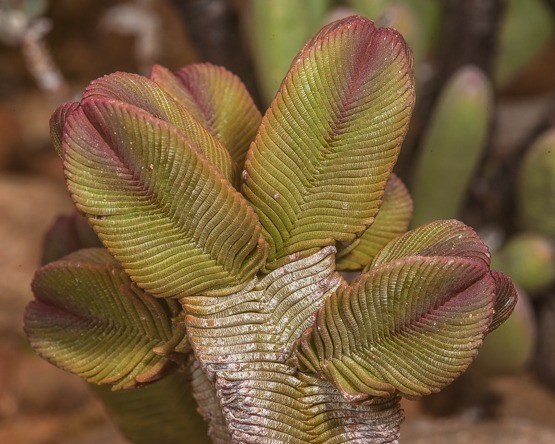
Although this species is widespread from the southern Great Karoo and the Montagu area to Somerset East, it is rarely common. It most often grows in shallow soil on rocky outcrops, on gravelly slopes and in crevices; usually on a north/north-east facing aspect.
As the pictures show, the plants are very variable.
Most often, the stems are erect, only rarely decumbent*. They are completely covered by the leaves, which are arranged in four neat ranks so that a quadrangular column is formed. This may be 0.6-2 cm in diameter and up to 25 cm tall (usually much shorter). Once a stem has flowered, it dies back, but new ones are formed at the base.
The leaves are green to grey-green or reddish-brown and the flowers white or cream-coloured.
Flowering time is spring: Aug.-Oct.
* creeping on the ground with the tips raised.
Synonyms: C. quadrangula, C. cylindrica, C. archeri.
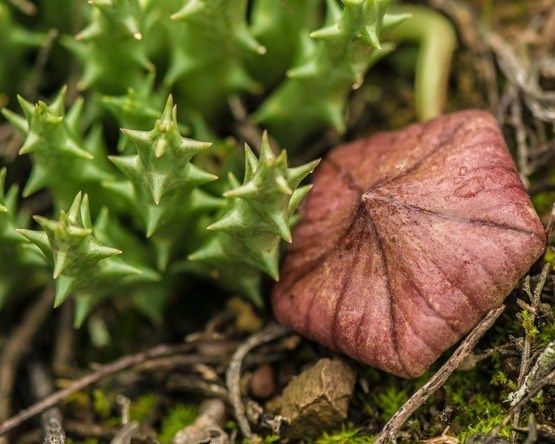
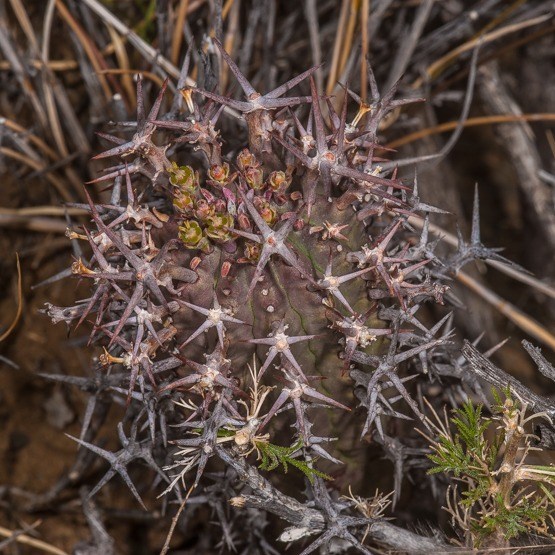
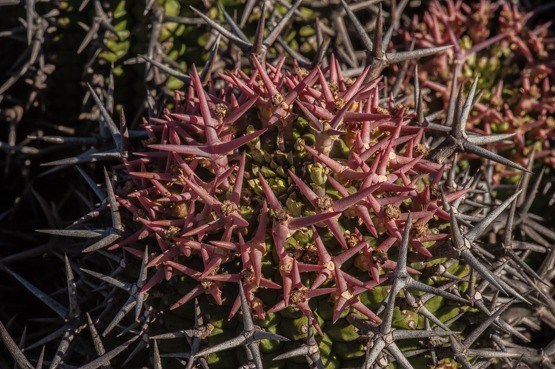
Usually found in dry scrub on shallow, stony ground, this attractive species is widespread in the Great Karoo where the plants form more or less dense clumps up to a meter tall and 1.5 m in diameter.
The branches are 3-8 cm thick, cylindrical to club-shaped, with 10-16 angles. The star-shaped spines to which the species name refers, are in fact modified fertile peduncles and are 0.4-2 cm long.
Flowers appear from July to September.
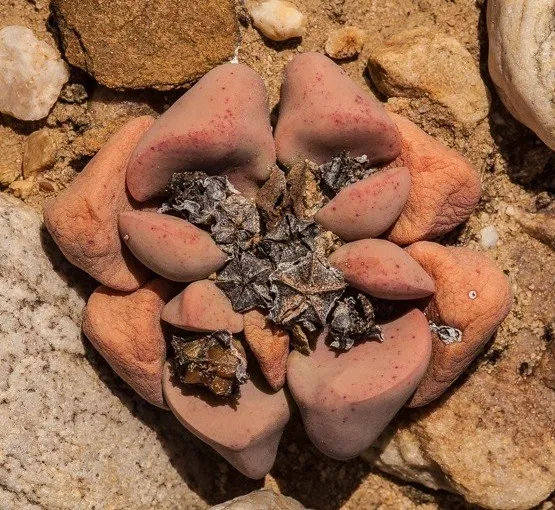
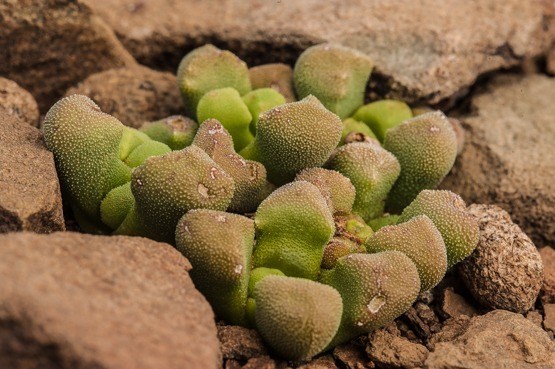
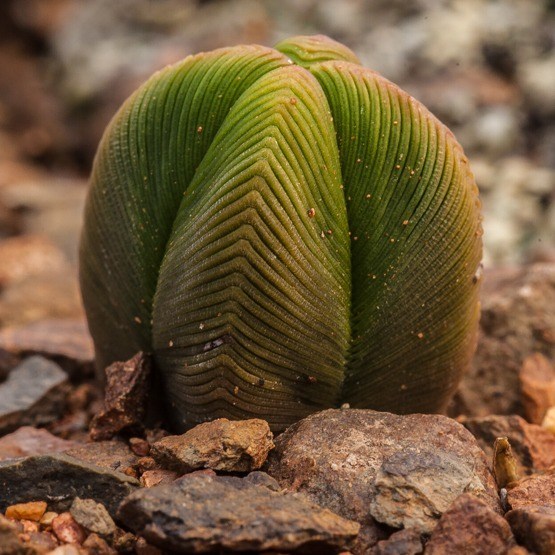
Didymaotus means twin-flowered and refers to the way in which (usually) a flower is formed on each side of the leaf-pair - a feature which is not found elsewhere in the family.
The plant bodies are single or form compact little clumps with age. Each body consists of leaves up to 4 cm long, broad and thick, usually greyish green or brownish-reddish.
The flowers are up to 4 cm in diameter, usually pink/purple, rarely white. They appear in September-October.
This curious plant is found in only a few localities in the Tanqua and southern Ceres Karoo, almost always together with Lithops comptonii. The rainfall occurs mainly in winter here.
More information can be found here: http://www.plantzafrica.com/plantcd/didylapid.htm