Warts and all

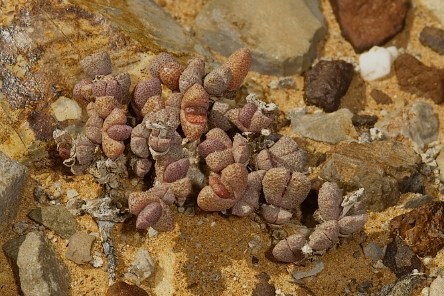
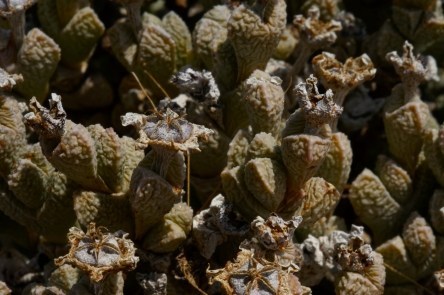
In a recent post (Cover up, 14th Jan.) I discussed how spines, hairs etc. help succulents conserve water. In some families we also come across plants where the leaves are (partly) covered in warts, papillae or tubercles. Although these are often highly decorative, it seemed likely to me that they would first and foremost serve a useful purpose. After doing a bit of research I came up with some interesting information.
It appears that the presence of these projections on stems or leaves has an advantage for the plants in that the breathing pores are hidden in the lower areas between them. This diminishes transpiration and protects the plants from dehydration.
In the case of warts, there is an additional advantage: their epidermis is rich in crystals and lies over cells that store up tannin. This combination makes the plant rather unattractive to herbivores.


Crassula tecta is named after the warts on the leaves (tecta =covered or protected)


Crassula corallina v. macrorrhiza (corallina = coral-like)
rhingran2010_09_12#009_lznres - Copy
In Rhinephyllum graniforme the genus name means file leaf


Haworthia scabra is aptly named too (scabra = rough)


This Astroloba used to be called A. aspera (=rough). The current name A. corrugata has a similar meaning (wrinkled or furrowed)
ruscmuri2010_09_05#038_lznres - Copy
Ruschia muricata is rough to the touch and that is exactly what muricata means

In the following two species the names make no reference to things like warts or tubercles, but it is clear that this is not because of lack of these.
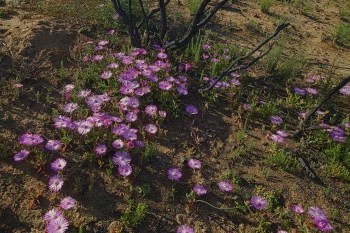
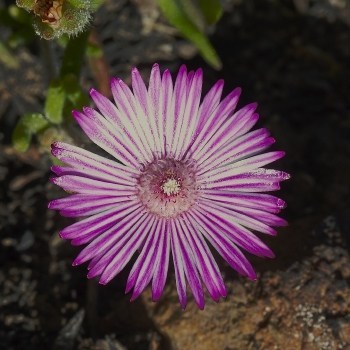
Aloinopsis spathulata


Stomatium suaveolens

Under cover; ways and means of conserving water

When looking at all those beautiful and unusual forms, colours and textures in succulents, it is easy to think that all this is there for our enjoyment. I’m afraid that is not the case; most of it is purely functional. For me, instead of being disappointing, this fact adds to my pleasure and admiration. What can be more likeable than things that are both useful and pleasing to the eye? In this post we will have a look at some of the contraptions that succulents use to conserve water.
The one thing that sets succulents apart from all other plants is their ability to store water that they can use during periods when there is no external supply. Obviously it is not much use to store a lot of water if you do not have the means to conserve it as well. Managing the stored water sparingly, mainly has to do with reducing transpiration.
The rate at which plants lose water by transpiration is influenced by a number of factors: size and form of the plant, temperature, humidity, intensity of sunlight, precipitation, wind speed, land slope etc.
On some days the temperature of the soil surface may rise as high as 75 degrees C, but a few centimetres higher up it will usually be much cooler (up to 40 degrees less ). The two extremes will be separated by a layer of still air.
Comparable layers with gradients of humidity and temperature are found above plant surfaces; they have a great influence on transpiration. These layers are disturbed or even destroyed by wind. Because of this, many succulents have a cover of hairs, spines, etc. on the surfaces of their leaves or stems. This helps in producing and protecting these layers. Such a cover also gives a certain shade and helps to diminish exposure to strong radiation –especially when it is light in colour. It has been found that tissue temperatures below spines of the cholla cactus (Opuntia bigelovii) can be reduced by as much as 11 degrees C.


In this Anacampseros albidiflora, short hairs on the leaves and long bristles between them, cooperate to keep the plant cool


Pelargonium barklyi is a tuberous plant. Although the leaves are short lived, it is apparently worthwhile to protect them with a cover of hairs


Haworthia arachnoidea gets its name from the spiderweb like cover of hairs. This variety is called scabrispina because the hairs are rough and hard like spines


In Senecio scaposus the leaves look like covered in felt

Many people think that spines are only there to protect the plants against browsing animals. In line with what we have discussed here, I think that spines play a certain role in that respect too, but that it is not the only, or even the most important, one.

In cases like Othonna euphorbioides (above) and Euphorbia stellispina -and in many other plants- the spines are actually hardened remains of inflorescences

Leaf and stem surfaces are often thickened too, or coated with a layer of wax (Senecio stapeliiformis, on top) or cork (Othonna herrei)

External water storage in succulents

The great majority of succulents stores water in stems, leaves and/or roots. Some of them however, mainly members of the vygie family (Aizoaceae) also make use of external storage. They have an epidermis covered with extremely enlarged and swollen cells (so called bladder cells) that are able to store water. Amazingly up to over 50 % of the total amount of water stored by the leaves can be located in these cells.

The cells have another advantage too: they are so big, that they create windless spaces above the stomata (breathing pores) so that transpiration is reduced. When a plant start suffering from drought stress, the cells collapse. This obstructs the passage of air to the stomata, so that water loss is reduced even further

One of the best known examples is the genus Drosanthemum (“dew flower”)

In this species (Mesembryanthemum guerichianum), the bladder cells are especially big on the calyx

Phyllobolus nitidus is named for its shining appearance (nitidus = glossy, polished or shining)

Exactly the same, but different; what post-production can do for your pictures.

A couple of months ago my wife and I were travelling to our farm near Matjiesfontein when we decided to have a short coffee break. As usual, I utilized this opportunity to quickly scan the area. Not far from the road I came across a plant of Cotyledon orbiculata (the beautiful form that used to be called undulata).


This picture shows my first attempt of photographing the plant.
It is not a bad photo, but neither does it convey the feeling I got when looking at the subject.


After cropping the picture this is what I got. Much better I thought, but too realistic.


Cropping in a slightly different way, combined with darkening the picture and enhancing the colours, resulted in this.
It seemed to me I was on the right track, but now the left side of the photo was too busy and distracting.


I had also made another picture, almost identical to the first one, but taken from a slightly different angle. When I closely compared the two, it became clear that the second one would be the best starting point for the picture I wanted.


I first treated the picture the same way as in number 3 and the lowered the contrast.
This is the end result, realistic enough to be of botanical value, but at the same time visually stimulating.

Water recycling in succulents

The editor of “Veld & Flora” ( http://www.botanicalsociety.org.za/) invited me to write an article on succulents for the magazine. It is now ready and will be published in the March issue.
The article is called “Miniature succulents – masters of survival” and highlights some of the intriguing adaptations miniature succulents deploy in order to survive. The following snippet will give you some idea of what to expect.

A peculiar adaptation is shown by many members of the mesemb family (Aizoaceae), especially the dwarf ones, which are able to recycle water from old leaves to new ones.
As the soil dries out towards the end of the growing period, the older leaves are gradually sacrificed and their water content is translocated to and stored in the younger ones. In this way, all available water reserves are concentrated in the last pair of leaves.
In the end, the dry remnants of the old leaves form a papery sheath acting as a protective layer of insulation for the new ones. When the next rainy period starts, the new pair reaches its final size and bursts through the old skin, ready for action.
It has been found that this adaptation enables plants to survive for about a year without any moisture supply from outside.


These three pictures of Antimima pygmaea were taken near Matjiesfontein in winter (mid August), spring (early October) and summer (end of January) respectively. At first, it would be hard to believe that it is all one species.

An interesting site

A short while ago I stumbled upon a website that turned out to be very interesting.
Here is the link: http://www.ispot.org.za,
and here is what they themselves say about the site:

“So what’s it all about?

iSpot is a website aimed at helping anyone identify anything in nature.

Once you’ve registered, you can add an observation to the website and suggest an identification yourself or see if anyone else can identify it for you.

You can also help others by adding an identification to an existing observation, which you may like to do as your knowledge grows. Your reputation on the site will grow as people agree with your identifications.

You may also like to visit our forums which offer lively debate around observations and other more general topics.”

A matter of colour (Pelargonium tetragonum)

The first time a saw a plant of Pelargonium tetragonum in the wild was in the vicinity of Calitzdorp. Later on I found out that the species was rather plentiful in the area, both north and south of the village.
The plants cannot be confused with any other species, but what surprised me was the colour of the flowers.

All the many plants I had seen in cultivation had pale pink flowers with deep red stripes on the upper two petals. All the plant I saw in the wild, not just around Calitzdorp but also elsewhere, had cream flowers (with the same red stripes as in the cultivated ones).

The more I thought about this phenomenon, the more I got the idea that the plants in cultivation originated from one or a few ancestors with an aberrant flower colour.
Last months I was in the Eastern Cape looking for plants with my wife and two Belgian plant friends. While trying to find my way into a dense thicket near Uitenhage, I suddenly came across several plants of this species with beautiful pink flowers.

So clearly the flower colour has to do with the area where the plants grow. According to J.J.A. van der Walt in “Pelargoniums of Southern Africa” (1977) the species occurs ” in a strip parallel with the coast from the Worcester-Caledon districts eastwards to Grahamstown. It has also been collected further inland near Graaff Reinet and Bedford”.
In their natural habitat the plants flower from September to December.

An unexpected pleasure (Drosanthemum striatum)

A few weeks ago my friend George Hattingh, who is about as mad about succulents as I am, told me that he had seen some beautiful succulents in flower which he could not identify. They were growing on top of the Rooiberg, a little mountain range just South of Calitzdorp which you have to cross on the way to Vanwyksdorp. As the road meanders its way up, it takes you through different vegetation zones. At the lower slopes a lot of succulents are found, whereas the plateau with its moister and colder climate is covered in arid fynbos. In winter and early spring the fynbos is at its best, with many different plant in flower. This type of vegetation harbours only few succulents, but some of the ones that do grow there are rather interesting. One of the plants George had found is probably an Antimima, but these I often find difficult to name. All suggestions are welcome.

The other species was clearly a Drosanthemum, but which one? After going through the literature, the only species of which the description fitted was D. striatum. According to the “Red List of South African Plants” (2009) this is a vulnerable species with only 10 locations remaining after much its habitat has been transformed for wheat and vineyard cultivation. The distribution range is given as: Malmesbury and Worcester to Swellendam and Bredasdorp. This is well outside the Calitzdorp area (even the nearest of these places is at least a 100 kms away). This new find means that the species has a rather wider distribution than assumed; hopefully it also means that it is less vulnerable than thought.
The peculiar thing is that we never found the plants before. The most likely explanation is that -like many other fynbos plants- they only flowers after fire. Or maybe we just missed them because they were too well hidden by all the vegetation that is normally present. Even without flowers they would have been much more visible without all kinds of other plants hiding them. At this moment (about seven months after a big fire on the mountain) large patches are still almost bare, so anything colourful stands out.
Whatever the reason, it just shows that interesting botanical discoveries can still be found in this part of the world.
ImageImage

First post

This is the beginning of a blog that is focused on two topics. Firstly on anything that has to do with succulent plants, especially those growing in South Africa, because that is were I live.
Secondly on photographing plants, succulent or not, cultivated or in the wild.
These two things have kept me busy for many years and I have written and lectured on them for almost as long. I have the privilege of living in an area where interesting succulents grow almost on my doorstep and as I am retired I have lots of time to study and photograph them
.
Haworthia arachnoidea v. nigricans along the road near my home

I hope to provide you regularly with interesting information on these subjects. It would be great to hear from you and learn what you are interested in. Therefore I invite you to share your ideas, questions, comments and opinions with other readers.
If you would like to get some more idea of who I am and what I do, please have a look at my website www.noltee.com.