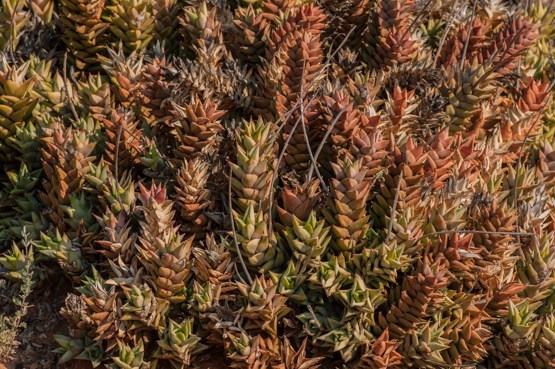
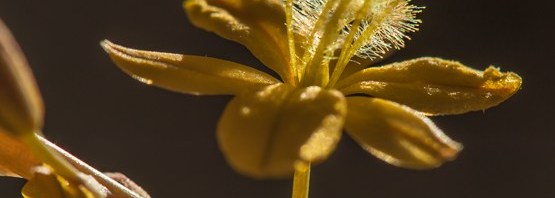
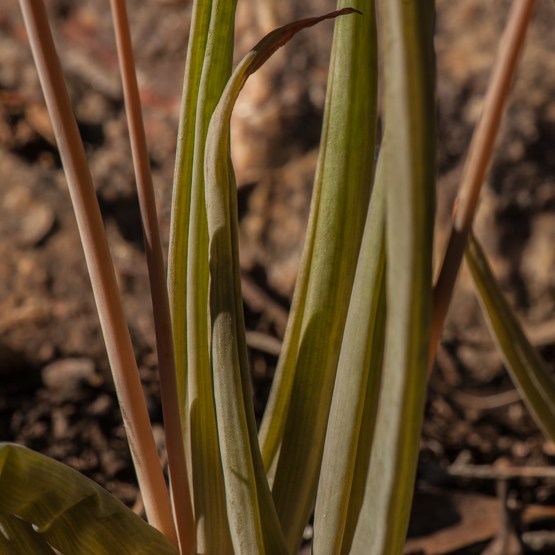
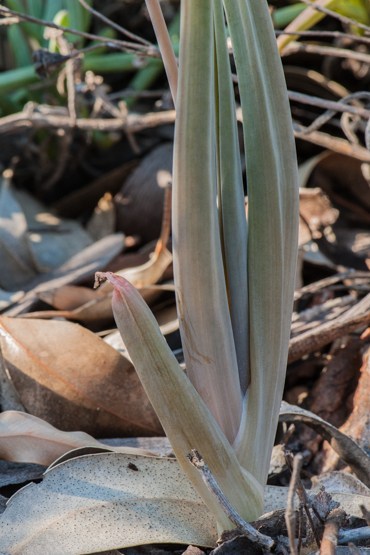
A while ago I published some pictures of Poellnitzia rubriflora’s beautiful flowers. They were taken in my garden, because it was only last August that I saw this species in the wild for the first time.
The plants occur in a small area between Robertson and Bonnievale (not far from where I live nowadays) on dry stony flats and low hills, usually under bushes. They form low clusters with stems up to 25 cm long.
DNA research seems to indicate that the genus Poellnitzia with its one species belongs in Astroloba, in spite of the rather different flowers.
The accompanying photo were taken 10 August 2014 in the Vrolykheid Nature Reserve near McGregor.
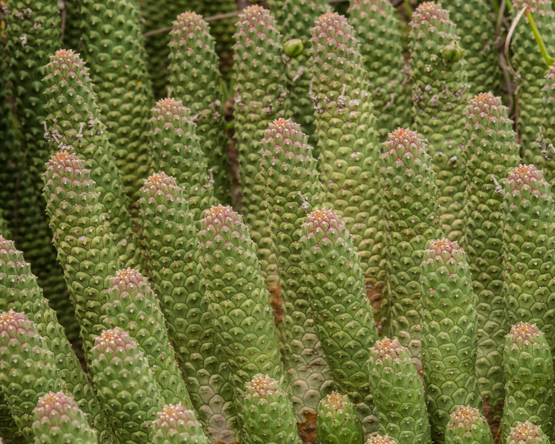
Of the about 30 species of the so-called medusoid group of Euphorbias, this is one of the biggest, sometimes reaching a metre or even more in diameter (including the branches).
It is very common over a large area stretching from the dry sandy plains east of Addo, northwards as far as Graaff Reinet and southwestwards towards the Baviaanskloof and the eastern border of the Little Karoo.
When the substrate is very hard, the main body is pushed above ground.
The name esculenta means “edible”, because the plants can be used as fodder in times of drought.
The flowers with their white woolly bracteoles give off a pleasantly sweet scent.
Plants of this species form clumps up to 15 cm tall and about 60 cm in diameter. The name refers to the armour of strong, usually straight, spines, which may be up to over 3 cm long.
The plants are found on flats and rocky outcrops from the western Great Karoo to Graaff-Reinet and Steytlerville, often in great numbers.
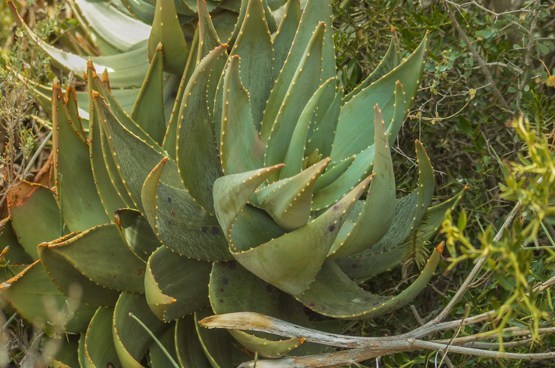
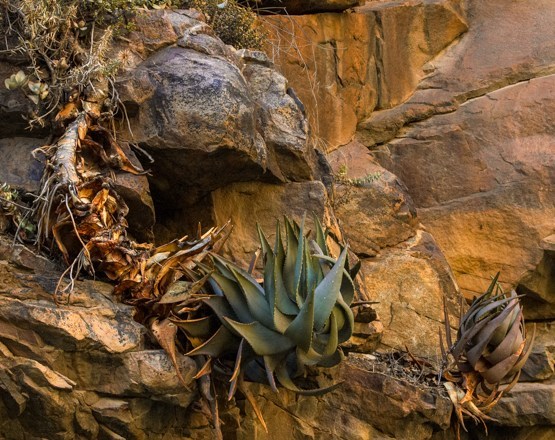
In 2000, Glen and Hardy came to the conclusion that Aloe comptonii, A. distans and A. mitriformis were to be united, under the old name A. perfoliata.
This species is most common in the Little Karoo, bur occurs from the Bokkeveld Mountains in the northwest to Genadendal in the south and Uitenhage in the east. The plants are usually found on sandstone or quartzitic outcrops where they often hang down vertical cliffs with stems up to 3 m long. The leaves are bluish-green and up to 25 cm long.
The flowers vary from dull orange-red to bright red and appear from August to February.
Today we’ll have a closer look at the plant and especially its flowers.
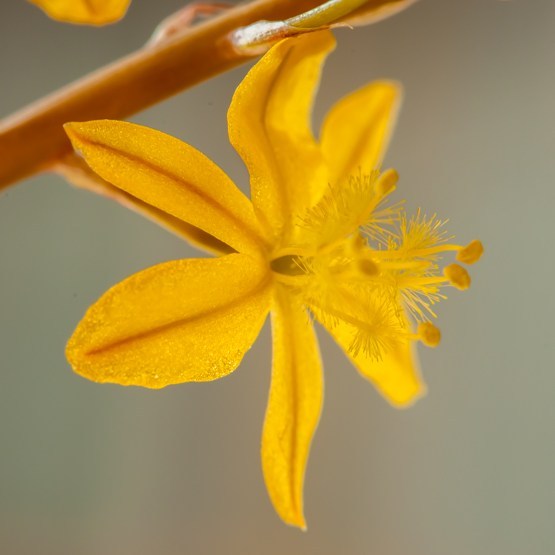
In yesterday’s post I mentioned the fact that most Bulbine flowers are very similar. That might give one the idea that they are not beautiful or interesting. Hopefully the pictures will convince you of the contrary. (Personally I’m rather chuffed with the last one, where the backlight shows off the bearded filaments beautifully).
Bulbines are easy to recognize as such when they are in flower. No other plants that I know of have the same peculiar bearded filaments. In general, the flowers are much of a muchness as to shape and colour (almost always yellow). This is one of the reasons many species are not easy to identify.
B. praemorsa is a common and widespread species, occurring from southern Namaqualand to the southwestern Cape, usually on sandy soils or rocky sandstone slopes.
The plants posses a small tuberous rootstock and long, thick and fleshy leaves that are deeply channeled above. The inflorescences are up to 60 cm tall, with yellow to orange or salmon-coloured flowers which appear from June to September.
“After three consecutive posts on one species, I will not mention it for a while now. Promise.” I wrote this in October last year and the species I referred to was the same one as the subject of this post. After being silent on the topic for some ten months, I now have reason to bring it up again.
Last Sunday I visited “Vrolykheid Nature Reserve”, which is situated between Robertson and McGregor. The plant pictured here was only one of a couple of interesting finds this little known reserve proved to have in stock.
When I had a look at some plants of Drosanthemum speciosum with very dark scarlet flowers, I suddenly noticed one plant with exquisite silvery pink flowers. In all other respects it looked like a run-of-the-mill D.speciosum. Nevertheless I checked out all my available literature and found out that the flower colour is described as “red to orange” and” bright orange to crimson”.
The only book with a different opinion is “Vygies, gems of the veld” by Van Jaarsveld en De Villiers Pienaar. What they say is the following: “Flowers up to 50 mm in diameter, usually orange, flaming scarlet or red. There are however yellow, rose-pink and even pale pink or straw-coloured forms of the plant.”
There is a similar species with pink flowers growing near Ceres (D. bellum), but there the leaves are more or les cylindrical and recurved at the tip, whereas in D. speciosum the leaves are “semi-cylindrical or trigonous, incurved like horns”.